
Arrest Records in Norfolk County
An arrest record is created the moment a person is taken into custody. Local police in any of Norfolk County's cities and towns make the initial arrest, and booking happens either at the local station or at the Norfolk County Correctional Center at 200 West Street, Dedham. The record includes the person's name, date of birth, the charge or charges at the time of booking, and sometimes a booking photograph. It may also note whether the person was held or released, and on what conditions. The Norfolk County Sheriff's Office under Sheriff Patrick W. McDermott operates the county jail and house of correction at the same address.
An arrest record and a criminal court record are not the same thing. Arrest records come from law enforcement at the point of booking. A criminal court record begins only after the prosecutor's office decides to file charges in court. Someone can be arrested and booked but never charged. Someone can be charged but later have the case dismissed. The arrest record can still exist in that person's history even when there is no conviction. For full case histories, pleadings, and dispositions, see Norfolk County court records.
Norfolk County covers 28 cities and towns, and each municipality has its own police department handling local arrests. The Norfolk District Attorney's Office, led by DA Michael W. Morrissey, prosecutes criminal offenses that occur across all those cities and towns. Once the DA's office files in court, the matter becomes a court case and the court record starts. These are two separate paper trails kept in two separate places.
How to Search Norfolk County Arrest Records
No official public Norfolk County jail booking roster or arrest blotter was located on the Sheriff's website during research. The official site publishes visitor information, mail rules, and reentry resources, but not a searchable public booking list. That is common in Massachusetts: the state does not have a statewide publicly searchable arrest blotter, and many individual county sheriff sites do not post one either. To verify current custody, call the Norfolk County Correctional Center directly at 781-329-3705. Do not rely on third-party aggregator sites for custody status; their data can be days, weeks, or months out of date.
That said, several official routes exist for finding arrest and criminal record information in Norfolk County. Each serves a different need.
- Call the Norfolk County Sheriff (781-329-3705). The fastest way to confirm whether a person is currently in custody at the county jail. Jail staff can tell you if someone is held there and may be able to give a general booking date or pending court date.
- Search MassCourts eAccess. The Massachusetts Trial Court Case Access portal is free and public. Choose the correct court department and Norfolk location, then search by case number, name (civil only), case type, or citation number. A case appearing in MassCourts means charges were filed in court. An arrest that did not lead to charges will not appear here.
- Contact the District Court Clerk-Magistrate. For misdemeanor arrests, the relevant District Court division handles arraignments and case files. The five Norfolk District Court divisions are in Brookline, Dedham, Quincy, Stoughton, and Wrentham. Each has a Clerk-Magistrate who can confirm whether a case was filed and what the docket shows.
- Request a CORI through DCJIS. The Department of Criminal Justice Information Services (DCJIS) administers Massachusetts Criminal Offender Record Information (CORI). Some CORI reports are available to individuals about themselves and to authorized requesters. CORI is a broader criminal history report and is separate from a single booking record or court docket.
- Contact the arresting police department. Local police departments in Norfolk County respond to public-records requests for arrest reports and police logs under the Massachusetts Public Records Law, M.G.L. c. 66, §10. Ongoing investigations, privacy exemptions, and victim-identity protections can lead to redactions. Use a written request to preserve the right to appeal a denial to the Supervisor of Records.
The juvenile record statute is an important limit on all of these routes. Arrests involving people under 18 generally produce records restricted by M.G.L. c. 119, §60A. Those records are withheld from public inspection unless a Juvenile Court justice consents, except when the youth is charged as a youthful offender on an indictment, in which case the proceedings are public like adult criminal records.
The juvenile record restriction statute is shown below, as it appears on the official Massachusetts Legislature site.
The text of M.G.L. c. 119, §60A governs access to Norfolk County juvenile arrest and delinquency records.
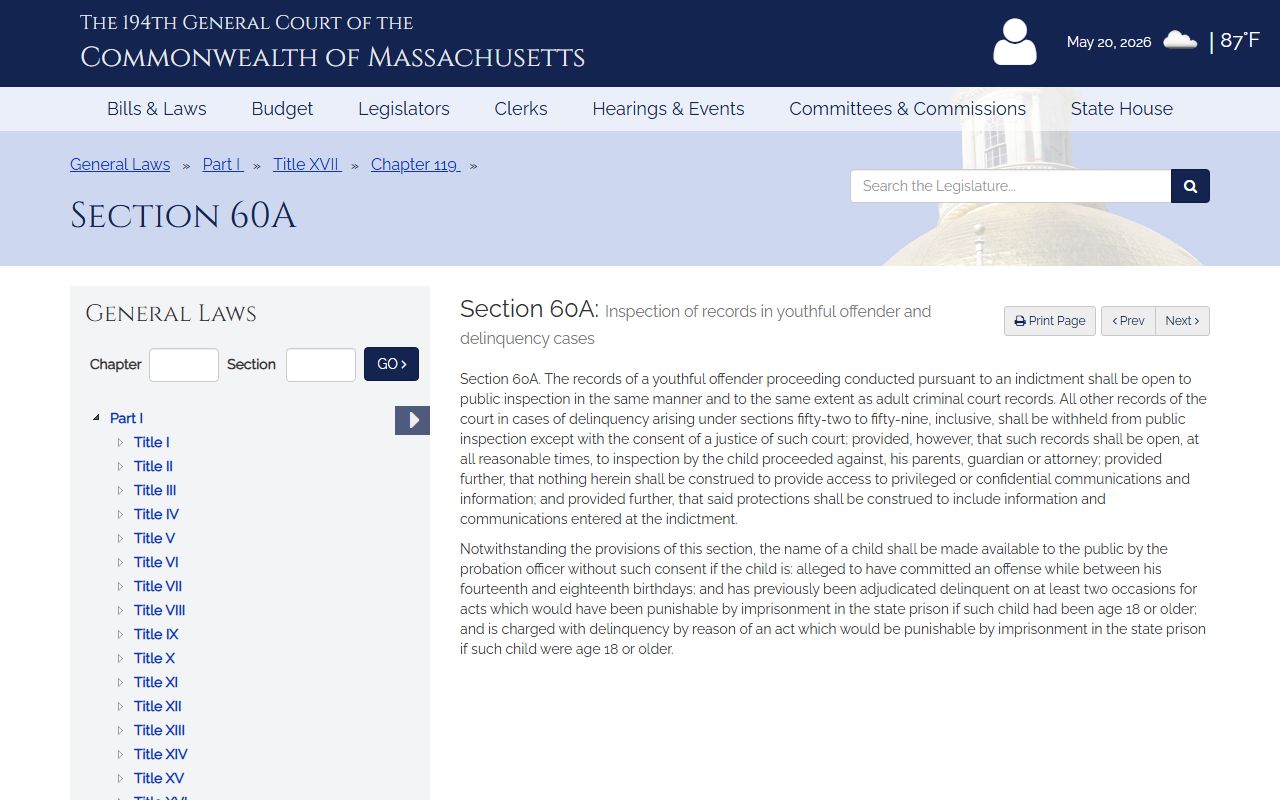
The statute means a juvenile booking record in Norfolk County is generally not accessible through the same channels as an adult arrest record.
Arrest Records vs. Criminal Court Records in Norfolk County
People often treat these terms as interchangeable, but they describe two different documents held by two different offices. Knowing the difference saves time when you are looking for specific information.
An arrest record is created by the law-enforcement agency that made the arrest, typically the local police department. It reflects what was known at the moment of booking: the name and identifying details of the person arrested, the charge or charges alleged at that time, and booking data such as date, time, and sometimes a photograph. Booking information at the county level goes through the Norfolk County Correctional Center if the person is held there. The arrest record exists whether or not charges are ever filed in court.
A criminal court record comes into existence when a prosecutor files a complaint or indictment in court. In Norfolk County, misdemeanor and lower-level criminal cases go to one of the five District Court divisions; felonies and serious matters go to Norfolk Superior Court at 650 High Street in Dedham. The court record tracks everything that happens in the case: arraignment, bail rulings, motions, trial events, plea or verdict, sentence, and probation. The Clerk-Magistrate at the relevant District Court or the Clerk of Courts at Superior Court maintains that file. Full court records, including how to find and read them, are covered on the court records page.
| Arrest Record | Criminal Court Record | |
|---|---|---|
| Source | Local police / Sheriff | Court Clerk-Magistrate or Clerk of Courts |
| Created When | At booking, when person is taken into custody | When a complaint or indictment is filed in court |
| What It Contains | Name, DOB, charges alleged, booking date, mugshot if taken | All filings, motions, hearings, disposition, sentence |
| Where to Get It | Arresting department or Sheriff; public-records request | MassCourts portal or clerk's office |
| Can Exist Without the Other | Yes, arrest without charges means no court record exists | Rarely without a prior arrest, but possible in some proceedings |
Note: A Massachusetts Superior Court case docket example uses the format 1473CV00213; a District Court example uses 1153CV000005. Searching MassCourts by case number requires exact capitalization, spacing, and leading zeros.
Charges vs. Convictions in Norfolk County Cases
A charge is an accusation. A conviction is a legal finding of guilt. These are not the same, and treating them as equivalent creates real harm for people in Norfolk County whose cases were dismissed or resolved in their favor. An arrest record showing a charge does not mean the person was convicted. A criminal court record can show a charge that later ended in a not-guilty verdict, a dismissal, or a nolle prosequi, which is the prosecutor's decision not to continue the case.
In Massachusetts, the standard for filing a charge is probable cause: a reasonable belief, based on specific facts, that a crime occurred and that the person charged may have committed it. The standard for conviction is proof beyond a reasonable doubt, which is significantly higher. That gap is why many arrests do not end in convictions, and why Norfolk arrest records and court records need to be read carefully rather than used as a proxy for guilt.
The Commonwealth of Massachusetts is the prosecuting party in criminal cases. When the Norfolk DA files a complaint or grand jury indictment, the case caption reads "Commonwealth v. Defendant Name". The appearance of that case on a public docket is not proof that the defendant did anything wrong. It proves only that the case was filed.
| Charge | Conviction | |
|---|---|---|
| What It Is | A formal accusation filed by a prosecutor | A finding of guilt by verdict, plea, or judicial admission |
| Legal Stage | Beginning of the criminal case | After trial, plea hearing, or admission of sufficient facts |
| Burden of Proof | Probable cause | Beyond a reasonable doubt |
| Appears on Public Record | Yes, once filed in court | Yes, as case disposition |
| Can Be Dismissed or Dropped | Yes, before or during trial | Not after final judgment; may be appealed or vacated |
| Affects CORI Report | Yes, even if not convicted | Yes, with distinctions for conviction vs. non-conviction outcomes |
Massachusetts has a disposition called "continued without a finding" (CWOF). This is not a conviction. The case is continued, and if the defendant meets conditions like probation, the case can be dismissed. But CWOF cases appear in CORI reports and can affect background checks until sealed.
CORI and the DCJIS Criminal History System
Massachusetts uses a parallel system for criminal history that is separate from public court dockets. It is called Criminal Offender Record Information, or CORI. The Department of Criminal Justice Information Services (DCJIS) administers CORI under M.G.L. c. 6, §§167-178B. CORI governs who can get what level of criminal history, under what circumstances, and for what purposes. It is not the same as doing a public docket search on MassCourts.
Public court dockets are accessible to anyone through MassCourts, subject to confidentiality rules for sealed, juvenile, adoption, and impounded records. CORI access is tiered. An individual can request their own CORI. Employers, landlords, and certain agencies can access CORI for background check purposes, but the level of detail they see depends on their category under the law. Criminal justice agencies get the broadest access. A member of the general public searching someone else's CORI through DCJIS has more limited access than an employer who has registered.
- CORI
- Criminal Offender Record Information. Massachusetts criminal history data managed by DCJIS. Includes arrests, charges, dispositions, and some probation records.
- DCJIS
- Department of Criminal Justice Information Services. The state agency that runs CORI, the warrant management system, and related law-enforcement data systems.
- CWOF
- Continued Without a Finding. A Massachusetts disposition in which a defendant admits to sufficient facts but the court does not enter a guilty finding. The case continues and can be dismissed after probation or conditions are met. It is not a conviction but it does appear in CORI.
- Nolle Prosequi
- The prosecutor's formal decision to stop pursuing a charge. A "nol pros" entry in a Norfolk County docket means the Commonwealth is not going forward on that charge.
- Arraignment
- The first court appearance after charges are filed, where the defendant is formally informed of the charges and bail conditions are set or reviewed.
One important access limit under CORI: a public-records request to a police department for an arrest report is different from requesting CORI through DCJIS. Police reports are municipal agency records and may be obtained through the Public Records Law, while CORI is a separate state database with its own access rules.
Mugshots and Booking Photos in Norfolk County
Booking photographs, commonly called mugshots, are taken at the time of arrest and booking. In Massachusetts, no state law specifically mandates public posting of mugshots by county jails or local police. The Norfolk County Sheriff's Office does not post a public mugshot gallery or booking photo database on its official website. Local police department booking photo practices vary by municipality and by the nature of the charge.
Because there is no official Norfolk County public mugshot database, some third-party websites aggregate booking photos from various sources and charge fees to remove them. Massachusetts does not have a specific mugshot removal law as some states do. If a case is sealed or expunged, however, Massachusetts law provides broader relief: sealed and expunged records are meant to be hidden from or destroyed in public-facing systems, and law enforcement is notified to request corresponding action from federal repositories under M.G.L. c. 276, §100T.
The adoption court record confidentiality statute also addresses how courts keep certain sensitive records out of the public domain. That statute, shown below, provides a useful framework for understanding how Massachusetts courts approach records that carry significant privacy interests.
The official text of M.G.L. c. 210, §5C governs adoption record confidentiality in Massachusetts courts, including Norfolk County Probate and Family Court cases.
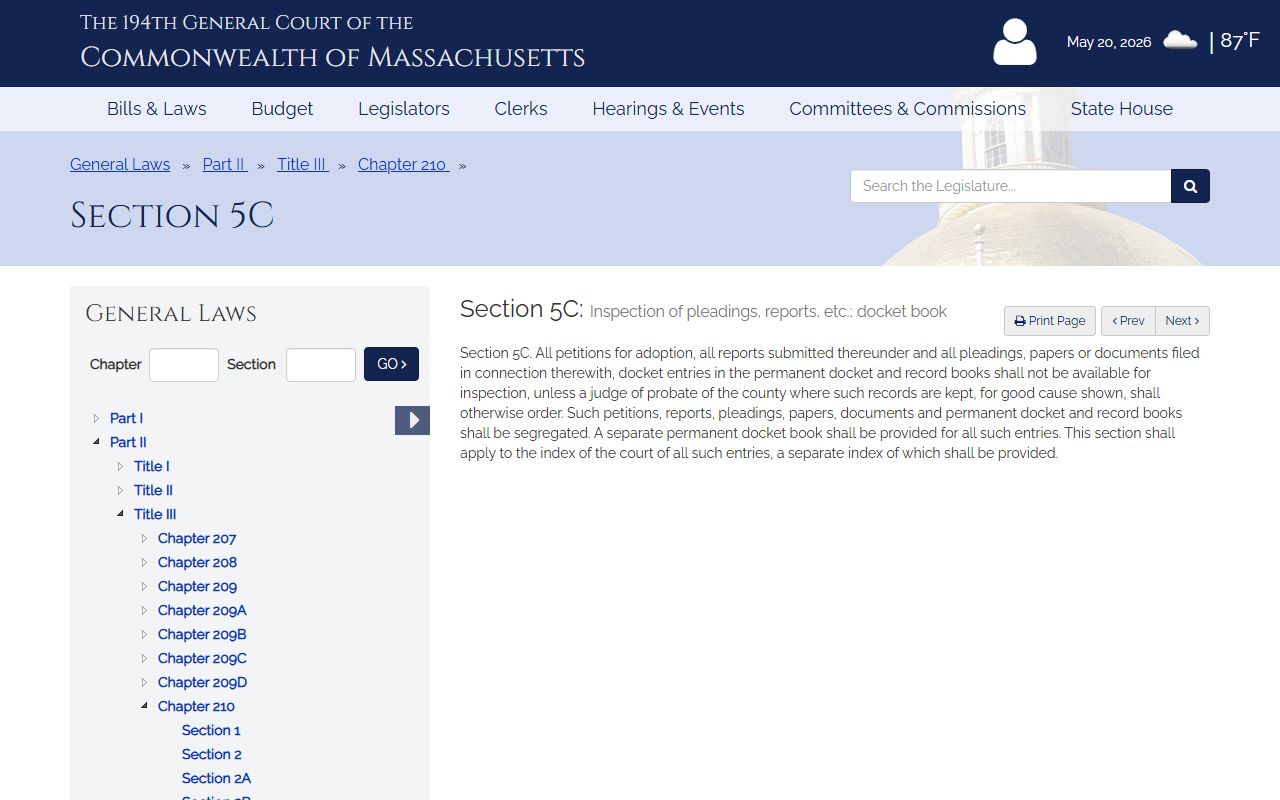
That same privacy philosophy runs through the juvenile record and sealed-record statutes that affect how Norfolk County arrest information is available to the public.
Sealed vs. Expunged Records in Massachusetts
Massachusetts gives people two distinct tools for clearing criminal history: sealing and expungement. They are not the same. Sealing hides a record from most public access but does not destroy it. Expungement goes further and aims at obliteration. Both are governed by specific statutes, and each has its own eligibility rules.
Conviction sealing is governed by M.G.L. c. 276, §100A. Under current Mass.gov guidance, misdemeanor convictions are generally eligible for sealing 3 years after conviction or release from jail or prison, whichever is later. Felony convictions use a 7-year waiting period under the same measure. Certain sex offenses and other excluded offenses have longer rules or may not be eligible at all. The statute is shown below as it appears on the Massachusetts Legislature site.
The M.G.L. c. 276, §100A conviction sealing statute sets the waiting periods and procedures that apply to Norfolk County criminal records.
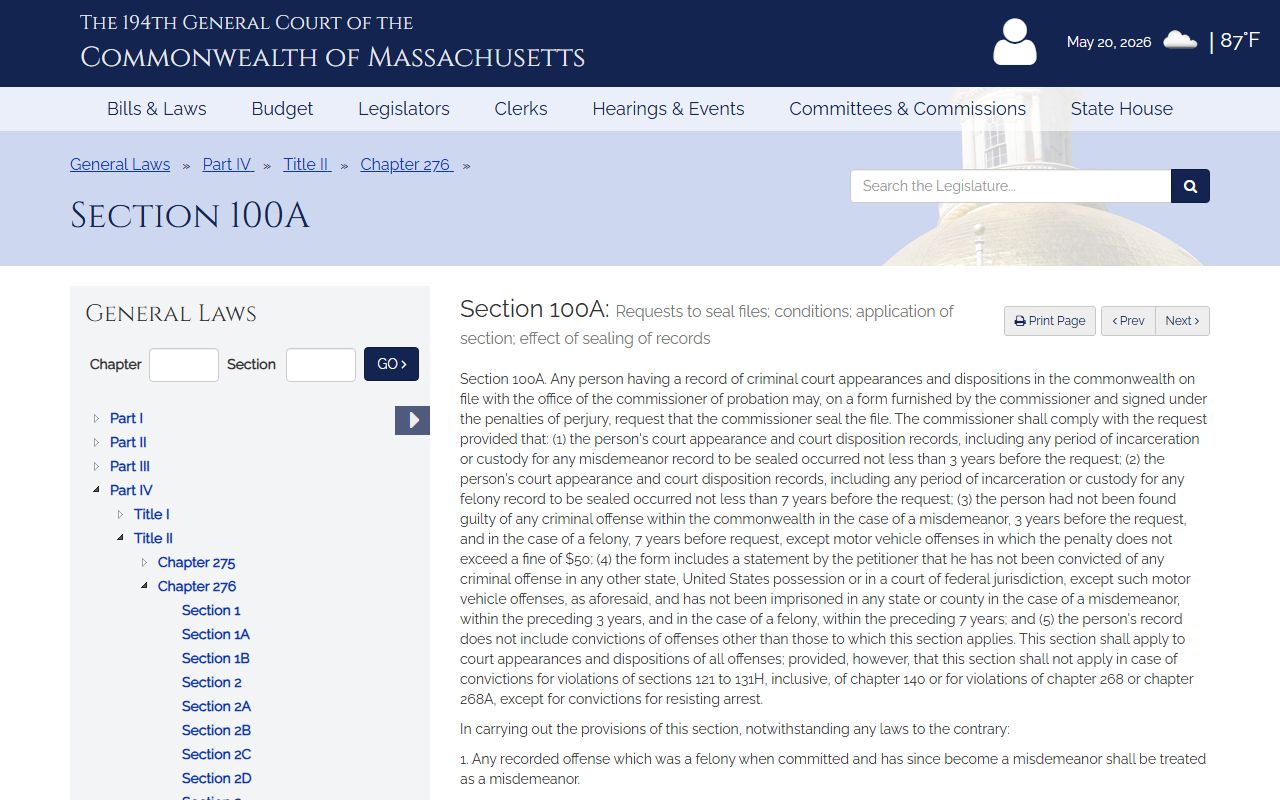
After sealing, the person can generally answer "no record" on most applications, though law enforcement and certain state agencies can still access sealed files.
Non-conviction sealing is handled under M.G.L. c. 276, §100C. This section applies to cases that ended in not guilty findings, no probable cause determinations, dismissals, or nolle prosequi entries. No waiting period applies to cases that ended in a not guilty finding. The statute text is shown below.
The M.G.L. c. 276, §100C non-conviction sealing statute allows people in Norfolk County to seal arrest records where charges were not proven.
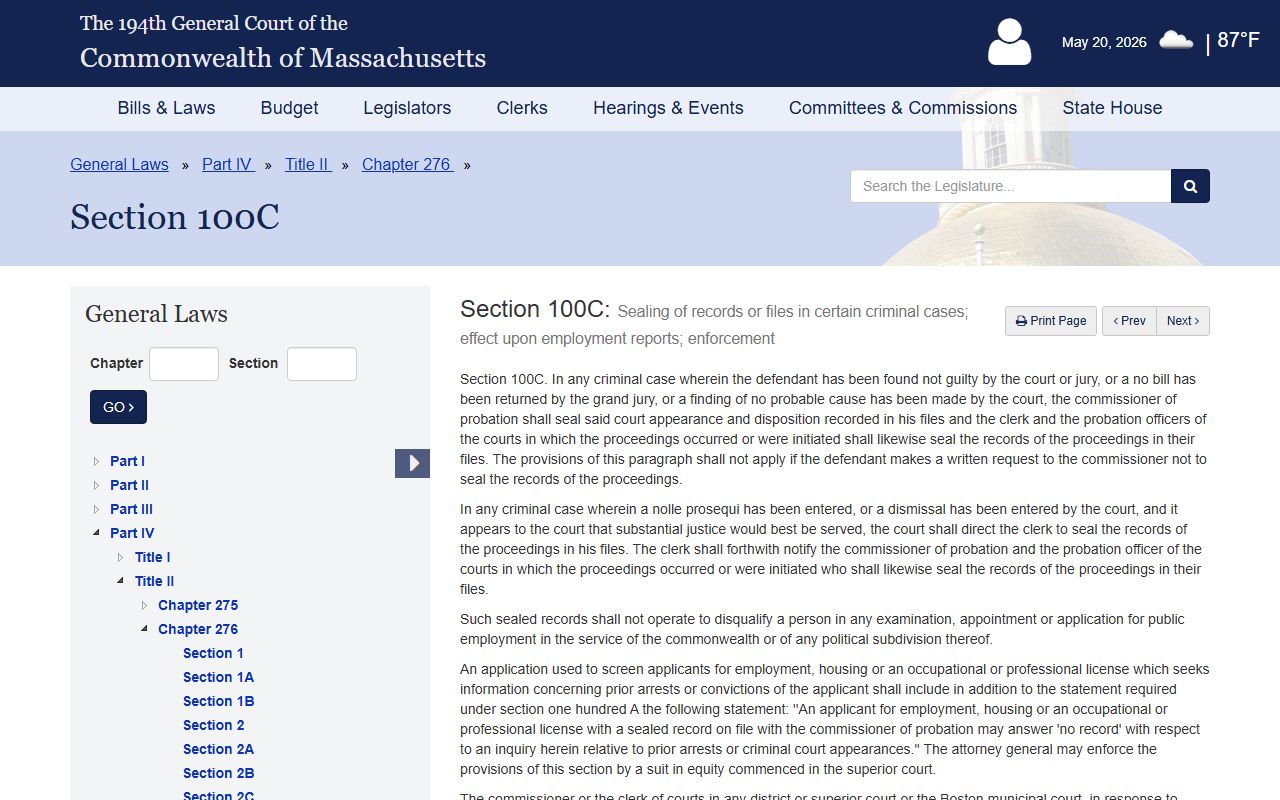
This matters because someone who was arrested in Norfolk County but whose case was dismissed still carries that arrest on their record until it is sealed.
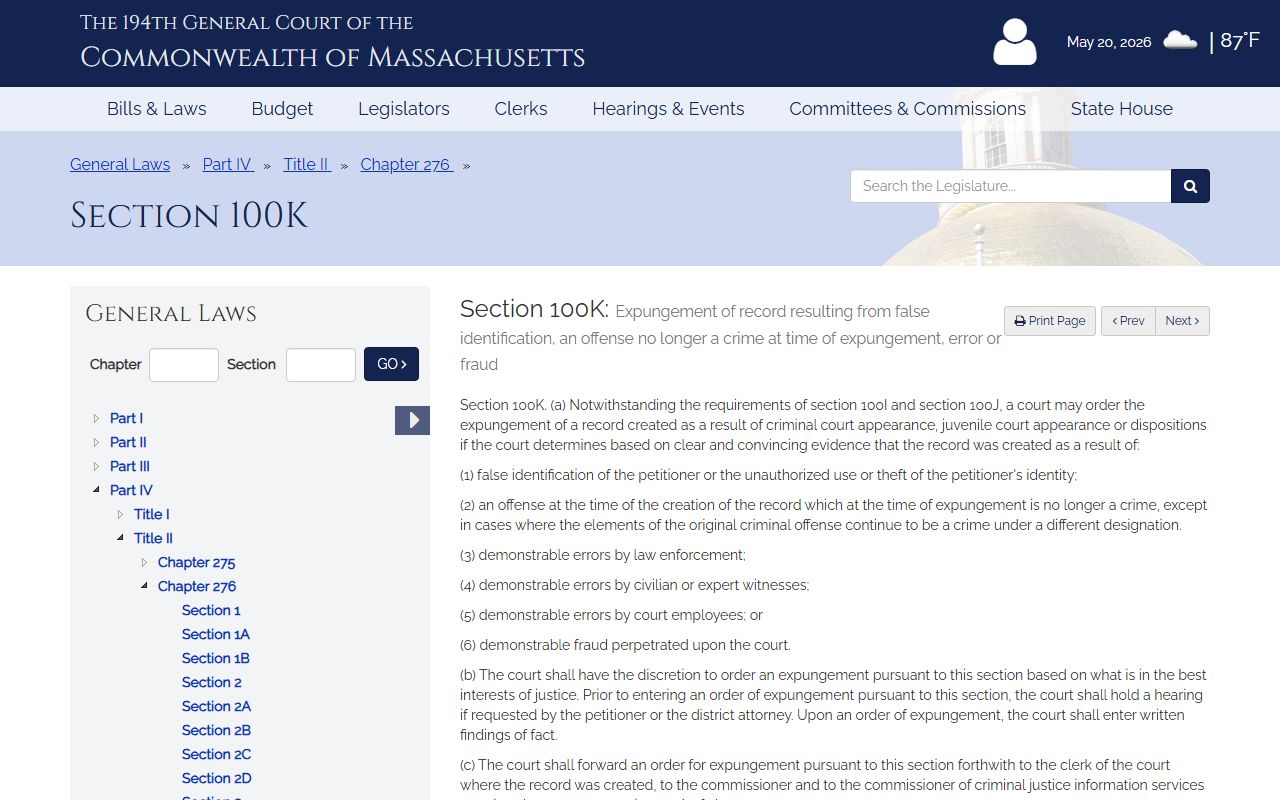
Expungement is narrower and is governed by M.G.L. c. 276, §100K. It applies in specific situations: where the record resulted from someone else using a false identity, where the conduct is no longer a crime, where fraud was committed on the court, or where there was official, witness, or law-enforcement error. A separate time-based expungement pathway exists for limited offenses committed before age 21. Judicial findings are required; it is not automatic.
The M.G.L. c. 276, §100K expungement statute governs the most complete form of criminal record relief in Massachusetts.
Even after expungement, the record is not guaranteed to disappear from all federal databases without a separate step.
| Sealed | Expunged | |
|---|---|---|
| What Happens to the Record | Hidden from public view; record still exists in court and law-enforcement systems | Record is obliterated or destroyed; treated as if it never happened in most contexts |
| Public Visibility | Not visible on MassCourts or CORI for most purposes | Not visible; much stronger protection than sealing |
| Law Enforcement Access | Limited access for specific criminal justice purposes | Very limited; some records of the order itself may remain |
| Applicable Statute | M.G.L. c. 276, §100A (conviction) or §100C (non-conviction) | M.G.L. c. 276, §100K (specific grounds) or §§100E-100U (age-based) |
| Waiting Period | 3 years (misdemeanor) or 7 years (felony) for conviction sealing; immediate for some non-convictions | No standard waiting period; must meet specific statutory grounds |
| Can Answer "No Record" | Generally yes for most purposes | Yes, in nearly all circumstances |
| Federal Notice Required | Yes, under M.G.L. c. 276, §100T | Yes, under M.G.L. c. 276, §100T |
Federal Notice After Sealing or Expungement
Sealing or expunging a Massachusetts criminal record does not automatically remove it from federal databases. State courts and law enforcement are required under M.G.L. c. 276, §100T to notify the Federal Bureau of Investigation and the Department of Justice after a Norfolk County record is sealed or expunged, and to request that those federal repositories take corresponding action. But federal agencies are not bound by state sealing orders in all circumstances.
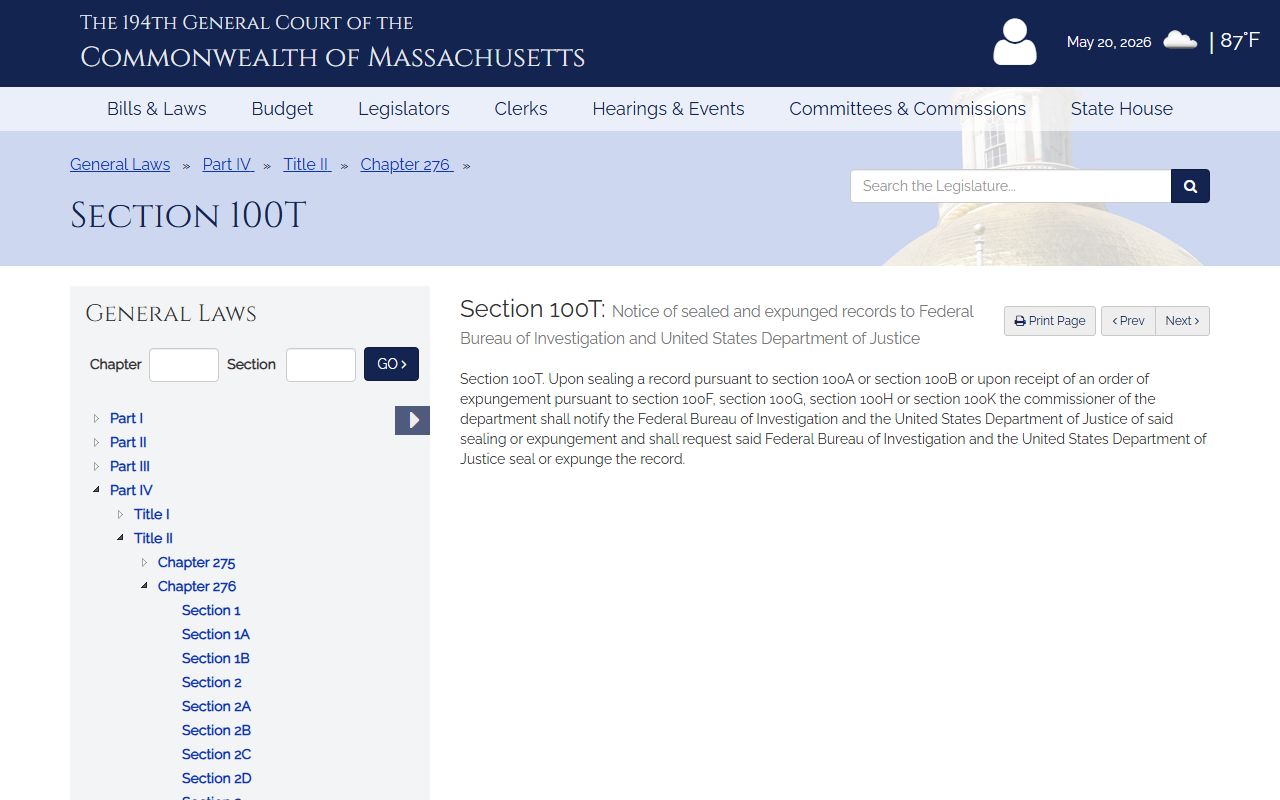
The §100T statute is shown below. It is relevant to anyone in Norfolk County who has gone through the sealing or expungement process and wants to understand the limits of that relief in a federal background check context.
The official text of M.G.L. c. 276, §100T sets out the FBI and DOJ notification obligation that follows a Massachusetts sealing or expungement order.
Someone who sealed a Norfolk County arrest record should confirm the federal notice was sent and, if possible, verify the FBI's response before assuming the record is gone from all systems.
Important: Sealing a Massachusetts record does not guarantee removal from all federal databases; M.G.L. c. 276, §100T requires state notification to federal repositories, but federal action is not automatic.
Background Check Considerations for Norfolk County Records
Background checks in Massachusetts involve at least two distinct systems: the CORI framework under DCJIS and the court docket data accessible through MassCourts. An employer, landlord, or other authorized requester doing a CORI check gets information governed by state law, with rules on what can be shown and when. A person searching MassCourts for a case docket gets public case data, which is broader in some ways but narrower in others because it does not include CORI-specific access tiers.
Under the federal Fair Credit Reporting Act (FCRA), consumer reporting agencies that compile background-check reports for employment, housing, tenant screening, or similar purposes face specific legal obligations. Those include rules about accuracy, dispute rights, and disclosure. Court records accessed through MassCourts or arrest data obtained from police departments are not automatically FCRA-compliant reports. They are raw public data.
For Norfolk County residents who are the subject of a background check, Massachusetts law provides some protections. CORI reform laws limit how far back certain employers can look and require employers to provide a copy of the CORI report before taking adverse action based on it. People who believe their CORI report contains errors have a right to challenge those errors through DCJIS. If a record was sealed under §100A or §100C, it should not appear on a CORI report given to most private-sector employers. If it does, that may be a legal error worth investigating with an attorney.
Greater Boston Legal Services provides civil legal aid that covers CORI and reentry issues for eligible Norfolk County residents. The Committee for Public Counsel Services handles criminal matters for people who qualify for appointed counsel. Both are relevant resources when a background check creates a barrier to employment, housing, or other necessities.
Important: This site is not a consumer reporting agency under the FCRA. Information found here is not to be used for employment, housing, credit, insurance, or any other FCRA-regulated background check purpose.
Restricted Norfolk County Arrest Records
Several categories of arrest and criminal records in Norfolk County are restricted or withheld from public access by statute, court rule, or order. Understanding these limits helps explain why a search that should turn up results sometimes comes up empty.
- Juvenile records. Under M.G.L. c. 119, §60A, delinquency and most juvenile court records are withheld from public inspection. Access is limited to the juvenile, parents, guardians, attorneys, and persons with court approval. The exception is youthful offender indictment proceedings, which are public like adult criminal trials.
- Sealed records. Once a Norfolk County record is sealed under §100A or §100C, it no longer appears in public court searches or most CORI reports. The record still exists for law-enforcement and specific authorized purposes, but the public cannot see it.
- Expunged records. Records expunged under §100K or the age-based pathway are treated as obliterated. They are not visible in public searches, and the person can answer "no record" in virtually all situations.
- Impounded materials. Under Trial Court Rule VIII, specific documents or materials in a case can be impounded by court order. An impoundment order limits access even to records that are part of a technically public case file. A docket may show a case exists but not let you see the impounded exhibits or affidavits.
- Ongoing investigations. Police reports for open investigations are often exempt from disclosure under the investigatory exemption in M.G.L. c. 4, §7, cl. 26. A request for an arrest report related to an active case may be denied or heavily redacted.
- Adoption records. Under M.G.L. c. 210, §5C, adoption petitions, docket entries, and related records at Norfolk Probate and Family Court are not available to the public unless a probate judge orders access for good cause.
Abuse-prevention orders under M.G.L. c. 209A may also restrict public access to specific addresses, affidavits, and safety-related information in the docket even when the docket entry itself is public. The court balances public access against victim safety in these cases.
Note: if a Norfolk County record does not appear on MassCourts, it may still exist at the courthouse. Remote access rules can suppress online visibility even for files that have some in-person public access.