
How to Look Up Norfolk County Jail Population Data
No live public dashboard for Norfolk County inmate population was found on the Norfolk County Sheriff's Office website during research for this page. The Sheriff's site publishes visitor information, reentry programs, and contact details, but not a real-time census count or population report. For current figures, the best path is to call the Norfolk County Correctional Center directly at 781-329-3705 or to look for official state publications produced under the Massachusetts FY2025 budget reporting requirements described below.
At the state level, population-related data has appeared through the State Auditor's review of the Norfolk County Sheriff's Office, which covered healthcare and inmate deaths. That audit provides the most specific official admission counts tied to this facility. The Bureau of Justice Statistics publishes an annual jail census through its National Survey of Jails program, and the Vera Institute of Incarceration Trends project aggregates county-level data from BJS surveys. Both are referenced in the context section below. Neither source replaces a current county-issued population report.
The State Auditor's audit landing page, shown below, is the official source for the figures cited throughout this page.
The State Auditor report on the Norfolk Sheriff healthcare and inmate deaths was released on July 26, 2024.
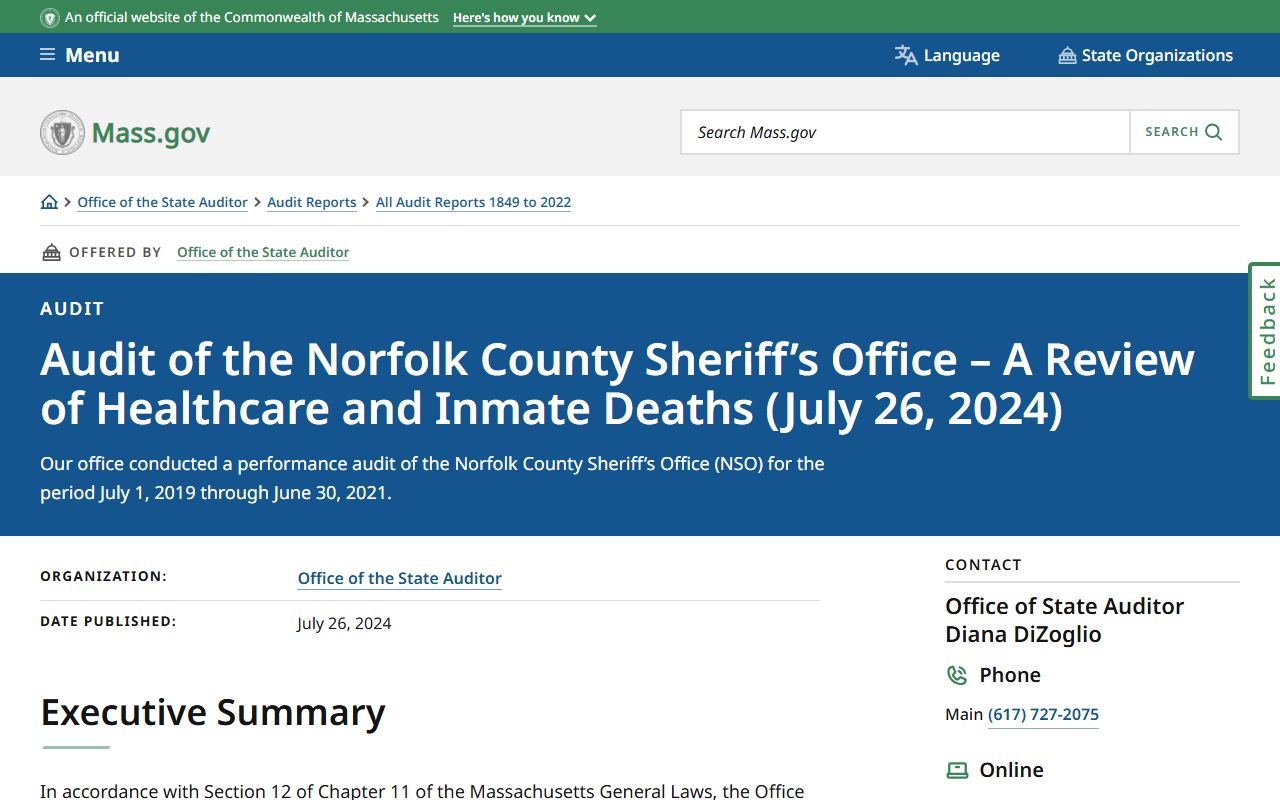
The audit covered a two-year period and documented the internal systems the Sheriff uses to track admissions and healthcare delivery for the inmate population.
Norfolk County Jail Capacity Overview
The Norfolk County Correctional Center / Jail and House of Correction at 200 West Street in Dedham is the main detention facility for the county. It opened in 1992 and is built between the northbound and southbound lanes of I-95/Route 128, which makes it one of the more distinctive correctional sites in Greater Boston. The facility holds people who are waiting for trial and people who have been sentenced to a county term. Under Massachusetts budget language, the Sheriff also reports data for state-sentenced inmates housed at the facility.
The H.O.P.E. Center at 2015 Washington Street in Braintree is a Sheriff community program site. It provides reentry services, recovery support, and community programming. It is not a jail housing unit. Rated bed capacity figures for the Correctional Center and any alternative program sites were not published in the official sources reviewed for this page.
| Facility | Address | Role | Rated Capacity |
|---|---|---|---|
| Norfolk County Correctional Center / Jail and House of Correction | 200 West St., P.O. Box 149, Dedham, MA 02027 | County jail; pretrial, county sentenced, state sentenced per budget reporting | Not published in official sources reviewed |
| H.O.P.E. Center | 2015 Washington St., Braintree, MA 02184 | Community program / reentry services; not a jail housing unit | N/A (community site) |
Note: The Sheriff site references alternative security pathways, including electronic incarceration for qualifying individuals, but capacity figures for those program slots were not located in official sources during this research.
Average Daily Population
A published average daily population figure for the Norfolk County Correctional Center was not located in the official sources reviewed for this page. The Sheriff's Office does not appear to publish a monthly or annual ADP report on its public-facing website. The State Auditor's audit, covering July 1, 2019 through June 30, 2021, recorded 4,350 total admissions over that two-year period. That figure is not an average daily population count but rather a cumulative admission total across the audit window. Dividing it evenly across 730 days would suggest roughly six admissions per day on average during that period, though actual daily fluctuations, releases, and multi-day stays mean the true ADP would differ from a simple admission-count calculation.
For current ADP data, the Massachusetts FY2025 budget item 8910-8600 for the Norfolk Sheriff requires the office to provide relevant data to the Executive Office of Public Safety and Security for quarterly recidivism reporting, starting with the quarter ending September 30, 2024. It also requires reporting to the Massachusetts Sheriffs' Association for the FY2024 total cost-per-inmate report. Those quarterly filings, once published by EOPSS or the Sheriffs' Association, would be the most reliable official source for current Norfolk County population figures. They were not yet publicly located as of the research date for this page.
Demographic Breakdown
Demographic percentages for the Norfolk County inmate population, including gender, race, and age distributions, were not found in the official sources reviewed for this page. The State Auditor's audit tested a sample of 60 inmate records for initial medical screening compliance. It did not publish a demographic breakdown of the full population. The Office Management System used by the Sheriff tracks full name, date of birth, and date of admission as core fields verified against source documents such as mittimuses or warrants. Those fields could support demographic analysis internally, but no public demographic report was identified.
National context from the Bureau of Justice Statistics provides comparison points. BJS jail surveys consistently show that male inmates make up the large majority of the local jail population nationally, typically around 85 percent or more. Pretrial detainees, meaning people not yet convicted, have accounted for roughly two-thirds of the national jail population in recent BJS reports. The Vera Institute's Incarceration Trends data allows researchers to filter by county and year to examine demographic trends where BJS survey data exists at the county level, but local-specific figures for Norfolk County were not confirmed through official county publications during research.
| Data Category | Norfolk County Status | National Reference (BJS) |
|---|---|---|
| Gender breakdown | Not published in official sources reviewed | Approx. 85% male nationally (BJS jail surveys) |
| Race / ethnicity | Not published in official sources reviewed | BJS jail census data available at state and national level |
| Age distribution | Not published in official sources reviewed | BJS publishes age breakdowns in National Survey of Jails |
Pretrial vs. Sentenced Population
The Norfolk County Correctional Center holds both pretrial and sentenced individuals. Massachusetts budget language for fiscal year 2025 uses the categories "pretrial," "county sentenced," and "state sentenced" to describe the reporting population. This means the facility is not just a pretrial holding center. It also houses people serving county sentences and, under state housing arrangements, some individuals sentenced under state jurisdiction. The Sheriff is required to report recidivism data for all three categories quarterly starting in fall 2024.
Specific pretrial and sentenced counts or percentages for the Norfolk facility were not published in the official sources reviewed here. The audit period visiting schedule on the Sheriff's website does distinguish pretrial units (labeled as Pre-trial) from sentenced housing units, which shows the facility physically separates these populations. Pre-trial units in the schedule include non-contact visits, while sentenced units may have contact visits depending on assignment. That operational detail confirms both categories exist but does not state their exact share of total population.
| Population Category | Status in Official Sources |
|---|---|
| Pretrial (awaiting trial) | Confirmed present; no published percentage located |
| County sentenced | Confirmed present; required in FY25 budget reporting |
| State sentenced | Confirmed present per budget language; no separate count located |
For national comparison, BJS jail data consistently shows that pretrial detainees account for roughly 65 to 70 percent of the total local jail population across the United States. That national figure is provided for context only and should not be applied as a Norfolk County estimate.
Misdemeanor vs. Felony Population
Misdemeanor and felony population breakdowns for the Norfolk County Correctional Center were not located in official public sources during research for this page. In Massachusetts, District Courts handle misdemeanor cases and lower-level criminal matters, while the Superior Court handles felonies and serious criminal charges. Both court tracks can result in county jail sentences or pretrial detention at the Correctional Center in Dedham, but no published count divides the current population by charge severity. The Sheriff's budget reporting requirements focus on the pretrial/county-sentenced/state-sentenced split rather than a misdemeanor/felony breakdown.
If you need to determine whether a specific case is a misdemeanor or a felony, that information appears in court docket records through the Massachusetts Trial Court Case Access portal under the relevant Norfolk court department. The case type and charge designation are part of the public docket record for cases that are not sealed or impounded.
Note: The research file for this page found no published Norfolk County data on misdemeanor vs. felony shares of the correctional population. Any figures from unofficial sources should be treated as estimates, not official counts.
Mental Health and Medical Population
The State Auditor's 2024 report provides the most specific data available on healthcare delivery to the Norfolk County inmate population. The audit covered the period from July 1, 2019 through June 30, 2021 and reviewed healthcare records maintained in the Sheriff's CorEMR system. CorEMR is the electronic medical records platform used to track healthcare provided to incarcerated individuals. The audit identified 6,176 healthcare records in the CorEMR system for the audit period. It also identified 630 sick-call request forms through a structured database query.
Massachusetts regulations require that each person admitted to a county correctional facility receive an initial medical screening upon arrival. The regulatory citation in the audit is 103 CMR 932.06(1). The Norfolk Sheriff's Office policy, as described in the audit, also required medical, dental, and mental health screening before placement in general population. The audit tested a random sample of 60 inmate admissions against this requirement and found that one of the 60 lacked documented evidence of an initial medical screening. That finding was the primary documentation exception identified in the audit's initial-screening testing.
The number of individuals specifically receiving ongoing mental health treatment, mental health caseload size, or the share of the population on psychiatric medications was not published in the sources reviewed. The audit focused on screening and documentation rather than aggregate mental health census figures. For general context, BJS surveys and the Vera Institute both document that mental health needs are common in the local jail population nationally, with some surveys finding that a majority of jail inmates have experienced mental health problems. No Norfolk-specific mental health population rate was confirmed.
The FY25 budget item for the Norfolk Sheriff is shown in the Massachusetts digital budget system, which is the source for the quarterly reporting requirements described throughout this page.
The Massachusetts FY25 budget item for the Norfolk Sheriff includes language on data reporting for pretrial, county-sentenced, and state-sentenced inmates.
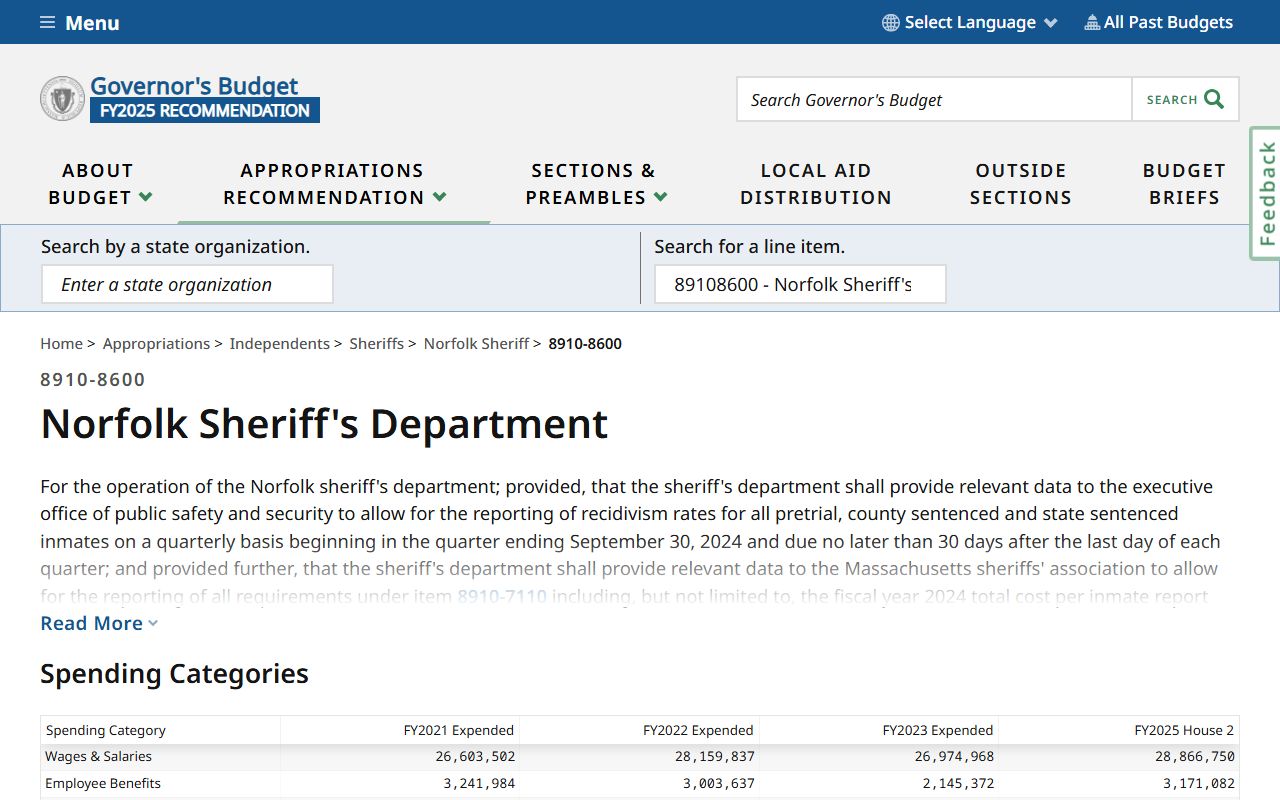
That budget language confirms the state expects population data from the Norfolk facility and sets the reporting structure for quarterly submissions to EOPSS and the Massachusetts Sheriffs' Association.
National and State Context
The Bureau of Justice Statistics publishes annual data on local jail populations through its National Survey of Jails and related programs. The most recent BJS data available as of this research found roughly 664,000 people held in local jails nationally on an average day, equating to approximately 198 people per 100,000 U.S. residents. Massachusetts has historically had jail incarceration rates below the national average, partly because the state's county sheriffs oversee house-of-correction facilities that often house people serving sentences of up to two and a half years, not just pretrial detainees. That structural difference means the Massachusetts rate is not directly comparable to states where county jails hold only pretrial individuals.
The Vera Institute of Incarceration Trends project uses BJS data to build a county-level database going back to 1970. It is a useful tool for identifying whether a county's jail population has grown, held steady, or declined over a multi-year period. Vera data for Massachusetts counties reflects the same reporting framework as BJS, with limitations in years where the survey sampling method affects county-level precision.
Norfolk County's own rate cannot be confirmed from public sources reviewed here. The comparison block below uses the national BJS figure and a general Massachusetts context note. The Norfolk County figure is listed as unconfirmed because rated capacity is unpublished and no official ADP figure was located.
| Level | Jail Population Context | Source |
|---|---|---|
| Norfolk County | Not confirmed from official sources; ADP and capacity not published | Norfolk Sheriff / State Auditor (audit-period admission count: 4,350 over 2 years) |
| Massachusetts | Below national average; county HOC structure differs from most states | BJS National Survey of Jails; Vera Institute |
| National (U.S.) | Approx. 198 per 100,000 residents (recent BJS reporting) | Bureau of Justice Statistics, Annual Survey of Jails |
These figures are clearly labeled by level. The national rate is from BJS and applies to the U.S. as a whole. The Massachusetts note is general context. Neither should be read as a confirmed Norfolk County rate.
Population Trends Over Time
A five-year or multi-year trend table for Norfolk County inmate population was not located in official public sources. The Sheriff's Office does not appear to publish annual population reports on its website. The most grounded historical data point in official sources is the audit-period admission count of 4,350 for the two-year period from July 2019 to June 2021. That span includes the height of the COVID-19 pandemic, a period when many jails across Massachusetts and the country saw population decreases due to court delays, bail reform practices, emergency releases, and reduced arrest activity. The audit also recorded one in-custody death during that period, attributed to COVID-19 complications.
The OJP abstract on the history of the Norfolk County House of Correction documents earlier periods in the facility's past, including a four-alarm fire in the North Wing in November 1978, repairs, and a reopening in January 1980. The current correctional center opened in 1992 to replace the older facility, which was subsequently converted to housing. The shift from the old facility on Village Avenue to the current site between the lanes of I-95/Route 128 represents the most significant structural change in the county's correctional history in recent decades.
The OJP abstract on the facility's history, available through the Office of Justice Programs, provides the earliest documented population and facility records for the site.
The OJP abstract on the Norfolk County House of Correction and Jail covers the facility's history from its earliest years through the period before the 1992 relocation.

That document establishes the historical arc of the facility and provides context for understanding how the current correctional center fits into Norfolk County's longer correctional record.
For more current trend data, look for Massachusetts Sheriffs' Association annual reports, EOPSS quarterly publications, and BJS county-level data through the Vera Institute Incarceration Trends tool. Those sources together provide the most complete picture of how the Norfolk County population has moved year to year since the FY25 reporting requirements took effect.
Searching for Norfolk County Inmate Records by Name
This page covers aggregate Norfolk County inmate population data, not individual-level custody records. No official public name search roster was located on the Sheriff's website. For individual inmate lookups, custody verification, or booking information, see the Norfolk County inmate records page, which covers how to contact the jail directly, how to use VINELink where applicable, and how MassCourts docket data relates to custody status.
Where the Data Comes From
The figures on this page come from a small set of official sources. The primary source is the State Auditor's July 2024 report on the Norfolk County Sheriff's Office, which reviewed healthcare delivery and inmate deaths during the July 1, 2019 to June 30, 2021 audit period. That report produced the 4,350 admission figure, the 6,176 healthcare record count, the 630 sick-call request form count, and the one in-custody COVID-19 death. The secondary source is the Massachusetts FY25 budget appropriation for the Norfolk Sheriff, which establishes the quarterly population-reporting framework that will produce future official data. National and state context comes from the Bureau of Justice Statistics and the Vera Institute of Incarceration Trends, both of which draw on federal jail census surveys.
Where data was not found in official sources, this page says so directly. The Sheriff's rated capacity, current ADP, demographic breakdown, and pretrial/sentenced percentage are all in that category. Using unofficial aggregator sites, inmate locator services, or third-party data estimates in place of official figures is not recommended for legal, employment, or other formal purposes. Always verify with the originating government office.