
What Probate Covers in Norfolk County
The Norfolk Probate and Family Court handles a wide range of legal matters that touch on death, family, and personal capacity. Estate cases make up the core work. When a person dies and leaves property that cannot pass by contract, beneficiary designation, or joint title alone, an estate may need to go through probate. The court appoints a personal representative, oversees the collection and distribution of assets, and can resolve disputes among heirs. Both informal and formal probate are available depending on how clear and uncontested the situation is.
Beyond estates, the same court department handles guardianship of minors and incapacitated adults, conservatorship over a person's financial affairs, trust petitions, name changes, and certain family matters including divorce, custody, and child support. Adoption cases are filed here as well, though adoption records are sealed by statute and not open to the public without a court order. The court's broad scope means one person may file here for a will, return years later for a guardianship, and file again for a name change, all in the same building.
Divorce and custody matters are a separate track within the same Probate and Family Court department. Those records are covered in more detail on the marriage and divorce records page. The focus here is on estate and guardianship probate.
Norfolk Probate and Family Court Location
There is one probate court serving all of Norfolk County. It sits in Canton, not in the county seat of Dedham. The court covers 28 cities and towns across the county, from Brookline to Wrentham. Free parking is available in front of and behind the building, which is helpful because public transit access is limited. The Providence and Stoughton commuter rail line stops about 1.5 miles away. If you cannot travel to Canton during business hours, the court's Virtual Registry lets you get help by Zoom on weekday mornings.
The court's official Mass.gov page is shown below, captured from the Norfolk Probate and Family Court location page.
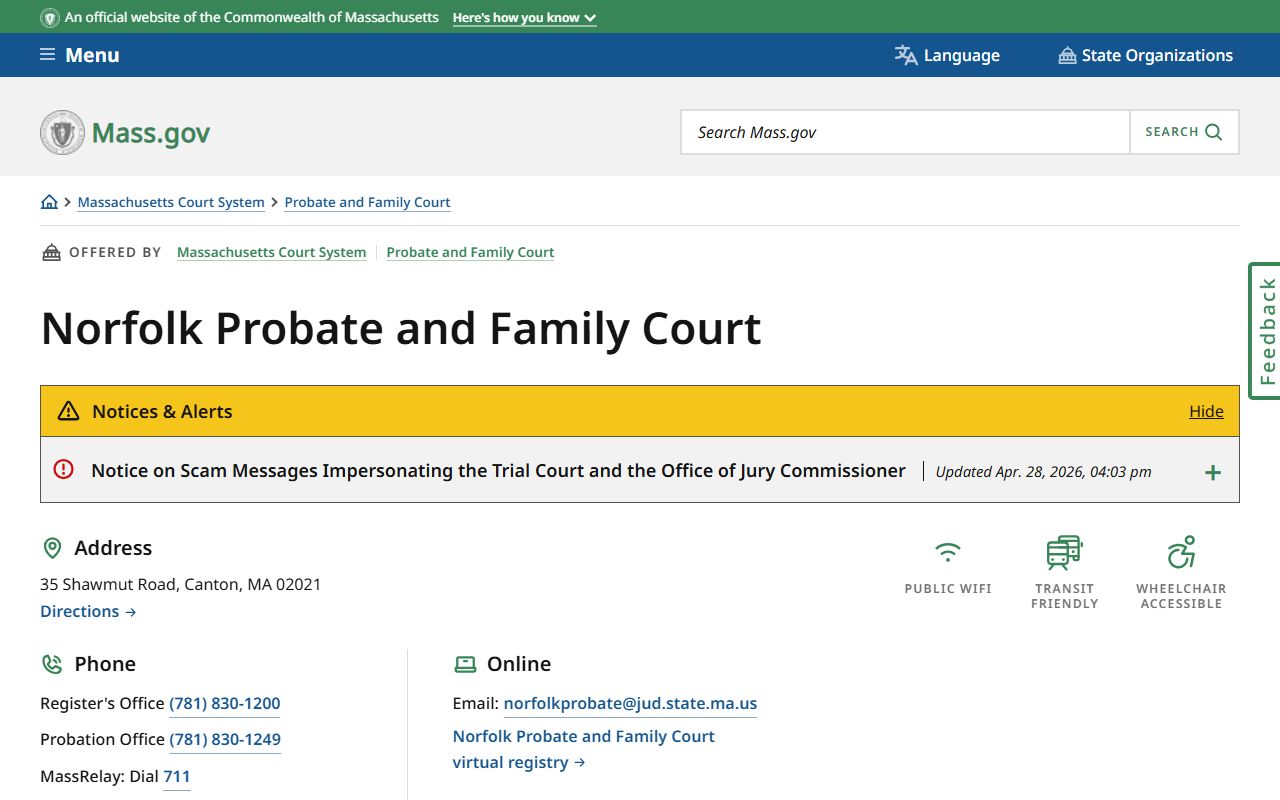
That page lists the Register's Office contact information, virtual registry hours, and parking details for the Canton location.
Norfolk Probate and Family Court
35 Shawmut Road
Canton, MA 02021
781-830-1200
norfolkprobate@jud.state.ma.us
Register: Colleen Brierley
First Justice: Hon. Lee Peterson
Hours: Monday-Friday 8:30 a.m.-4:30 p.m.
Virtual Registry: Monday-Friday 8:30 a.m.-1:00 p.m.
Zoom call-in: 1-646-828-7666 | Meeting ID: 1617846497
The Virtual Registry is a real-time Zoom session staffed by Register's Office personnel. It is useful for procedural questions, form guidance, and status checks when you cannot come in person. You do not need a Zoom account to call in by phone using the number and meeting ID above.
The virtual registry page is shown below, captured from the Norfolk Probate and Family Court virtual registry page.
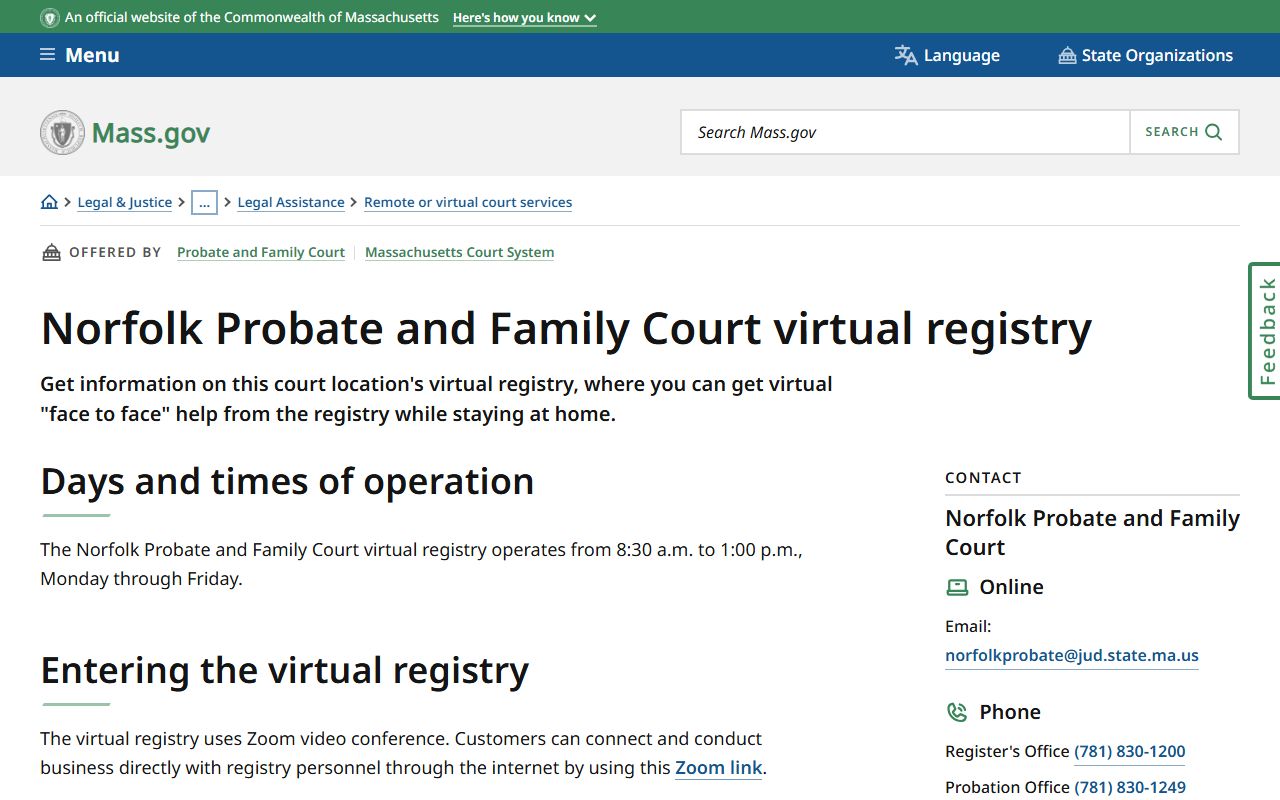
Registry staff can answer questions about pending estate cases, guardianship filings, and probate forms during those morning hours Monday through Friday.
Key Probate Terms for Norfolk County Filers
Probate filings use specific legal words that can be confusing at first. Knowing these terms before you search or file will help you read case dockets and understand what the court has done or is waiting for.
- Testator
- The person who made and signed a will. When a testator dies, their will is submitted to the probate court for review and, if valid, accepted as the guiding document for the estate.
- Executor / Personal Representative
- The person named in a will (or appointed by the court when there is no will) to manage the estate. In Massachusetts courts, the modern term is personal representative for both testate and intestate estates, but executor is still widely used in everyday speech.
- Intestate
- Dying without a valid will. When there is no will, Massachusetts law sets the order in which heirs receive the estate. The court still appoints a personal representative, but the distribution follows statute rather than the decedent's written wishes.
- Guardianship
- A court-approved arrangement giving one person (the guardian) legal authority to make personal decisions for another person who cannot make those decisions independently, such as a minor child or an adult found to be incapacitated. Guardianship cases are filed and supervised in the Probate and Family Court.
- Conservatorship
- A court-approved arrangement giving a conservator authority to manage the finances and property of a person who cannot do so for themselves. A conservator handles money and assets; a guardian handles personal care. One person can hold both roles, or two different people can be appointed for the same individual.
Note: Other terms you may see include "letters of authority" (the document the court issues authorizing a personal representative to act), "decree" (a court order), and "citation" (a formal court notice to interested parties).
Informal vs. Formal Probate in Norfolk County
Massachusetts gives estates a choice between two main probate tracks. Knowing which one fits your situation affects how quickly the court can act and who reviews the paperwork.
Informal probate is the faster, administrative route. A magistrate (not a judge) reviews the petition and, if the paperwork is complete and no disputes are expected, can issue an informal probate order as soon as seven days after the decedent's death. That seven-day window is a legal minimum, not a processing guarantee; actual timing depends on filing completeness and court workload. Informal probate works well when the will is clear, the heirs are known and in agreement, and there are no creditor or validity disputes. The process is managed through the Register's Office in Canton.
Formal probate goes before a judge. It is used when there are will contests, unclear or missing heirs, disputes among beneficiaries, complicated creditor claims, or any situation where judicial determination is needed. Formal probate takes longer but gives the court full authority to resolve disputes and issue binding orders. Some estates begin informally and later convert to formal probate if a problem surfaces.
The informal probate guide on Mass.gov is shown below, with the step-by-step process for filing an informal estate in Massachusetts.
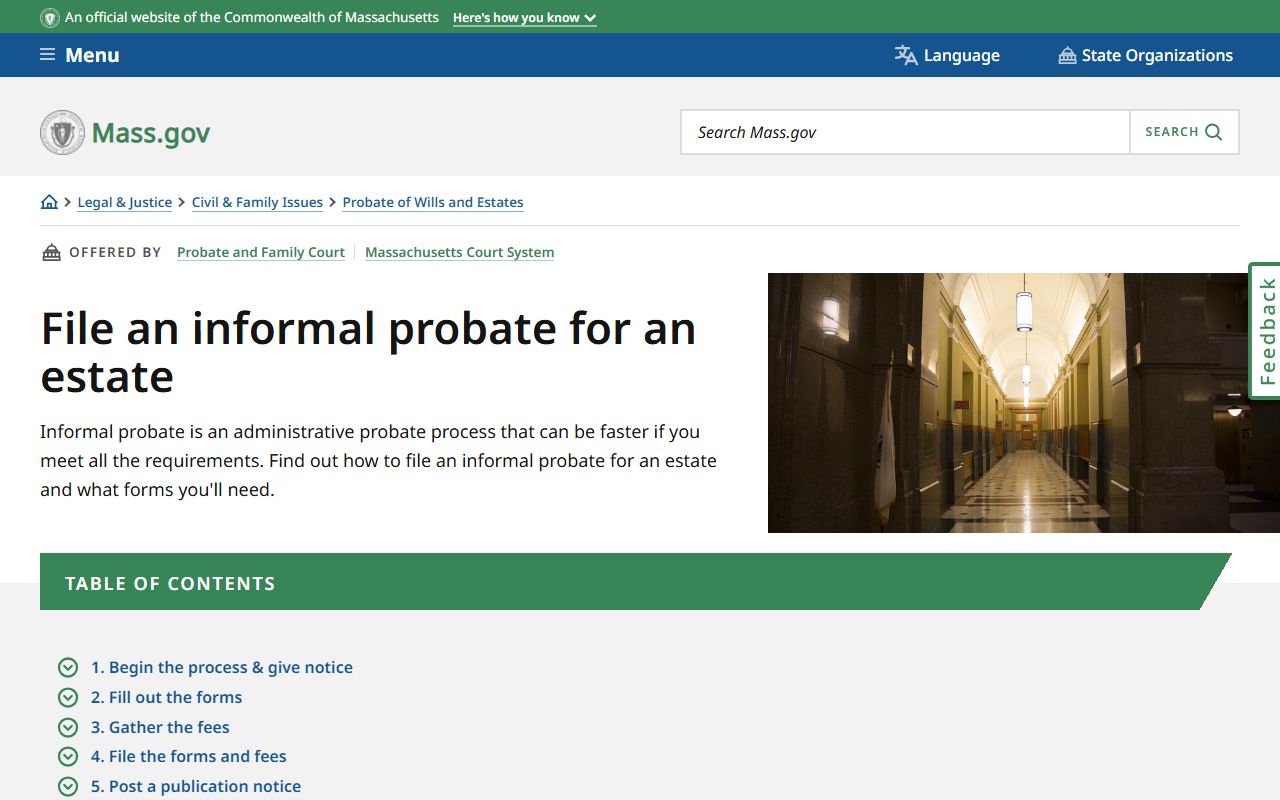
That guide covers which forms to gather, how to submit, and what happens after the magistrate reviews the petition.
How to Search Norfolk County Probate Records Online
Norfolk County probate records are searchable through the Massachusetts Trial Court Case Access portal, commonly called MassCourts. The portal is free and open to the public. It shows docket entries, case events, petitions, decrees, and party names for most active and recent probate cases. It does not produce certified copies. For official estate documents, you need to contact the Register's Office directly.
Probate case numbers have a specific format in MassCourts. An example from the official Mass.gov guide is PL14E0125QC, where the letters and numbers encode the department, year, and sequence. Case number searches require exact capitalization, correct spacing, and leading zeros. If you search by name rather than number, note that the Name tab in MassCourts covers civil cases, which includes probate matters, but results can still vary depending on how names were entered at filing.
- Go to www.masscourts.org and complete the "I'm not a robot" check, then click the button to enter the public search.
- In the Court Department dropdown, select Probate and Family Court.
- In the Court Division and Court Location fields, select the Norfolk division.
- Choose a search tab: Case Number (fastest if you have it), Name, or Case Type with a date range of up to one month.
- Enter your search terms and click Search. Click the case link in the results for the full docket and event history.
- For certified copies, call the Register's Office at 781-830-1200 or use the Virtual Registry Monday through Friday 8:30 a.m. to 1:00 p.m.
MassCourts works best when you already know the docket number. If you only have the decedent's name, start with the Name tab, but be prepared to call the Register's Office if the search returns no results. Old paper-era estate files may not be fully indexed online.
Norfolk County Probate Filing Fees
Massachusetts Probate and Family Court fees are set by the state and apply countywide. The court posts the current fee schedule through the statewide court filing fees and payment information page. Fees can change, so confirm the current amounts with the Register's Office before filing. The figures below come from official Massachusetts court materials and should be treated as reference estimates rather than final amounts.
| Filing Item | Fee (reference) |
|---|---|
| Informal or formal estate petition (certain filings) | ~$405 (confirm current) |
| Divorce and child custody petition | $215 |
| Summons (per summons) | $5 |
| Certified copy of probate record | Contact Register's Office |
| Guardianship or conservatorship petition | Contact Register's Office |
| Name change petition | Contact Register's Office |
Waivers and fee deferrals may be available for low-income filers. Ask the Register's Office or contact a legal aid resource such as Greater Boston Legal Services before assuming you cannot afford to file. The court cannot give legal advice, but clerks can explain the fee waiver process.
Estate Administration in Norfolk County
Administering an estate through the Norfolk Probate and Family Court follows a sequence of steps. The exact path depends on whether the estate uses informal or formal probate, whether there is a will, and how complex the asset picture is. The overview below covers the standard flow for most Norfolk County estate cases.
- Determine whether probate is needed. Not every estate must go through court. Assets that pass by beneficiary designation, joint tenancy, or living trust may not require probate. An attorney or the court's Virtual Registry can help you decide if filing is necessary.
- Gather key documents. Locate the original will if one exists, the death certificate, a list of assets and debts, contact information for heirs and devisees, and any military service records that may be needed for the military affidavit form.
- Choose informal or formal probate. If the estate is straightforward and no disputes are expected, informal probate before a magistrate is usually faster. If there are will contests or unclear beneficiaries, formal probate before a judge is the right track.
- File the petition and required forms. Submit the estate petition, will (if any), death certificate, and other required documents at Norfolk Probate and Family Court. You can file in person at the Canton courthouse, by mail, or by eFiling where eligible. The probate court forms list on Mass.gov has the current checklist for informal probate, inventory forms, account forms, and more.
- Pay the filing fee. Fees are due at filing. Bring a check or money order, or confirm payment methods before arriving. Ask about fee waivers if needed.
- Send required notices. After the petition is filed, the court may require you to give formal notice to heirs, devisees, creditors, and other interested parties. In informal probate, a notice by publication or direct mail may be required depending on the case type.
- Receive your letters of authority. If the court approves the petition, it issues letters of authority (often called letters testamentary or letters of administration). These are the documents that give the personal representative legal power to act on behalf of the estate.
- Collect, secure, and inventory assets. The personal representative must identify, collect, and safeguard estate assets. A formal inventory may need to be filed with the court depending on case type and size.
- Pay debts, expenses, and taxes. Valid creditor claims, funeral costs, court costs, and applicable estate taxes must be paid before distributing assets to heirs. Massachusetts has its own estate tax with a threshold separate from the federal estate tax.
- Distribute assets and close the estate. After debts are paid, assets go to heirs or devisees per the will or intestacy law. The estate is closed by filing an account, statement, or court decree depending on the probate type and court requirements.
The Probate and Family Court eFiling guide explains which case types and filing stages accept electronic submission and how to register for the system.
What Norfolk County Probate Records Show
When you pull up a probate case on MassCourts or request copies from the Register's Office, the record contains a set of standard fields and documents. The exact contents vary by case type, but most estate and guardianship records include the following information.
The full forms library is shown below, captured from the probate and family court forms page on Mass.gov.
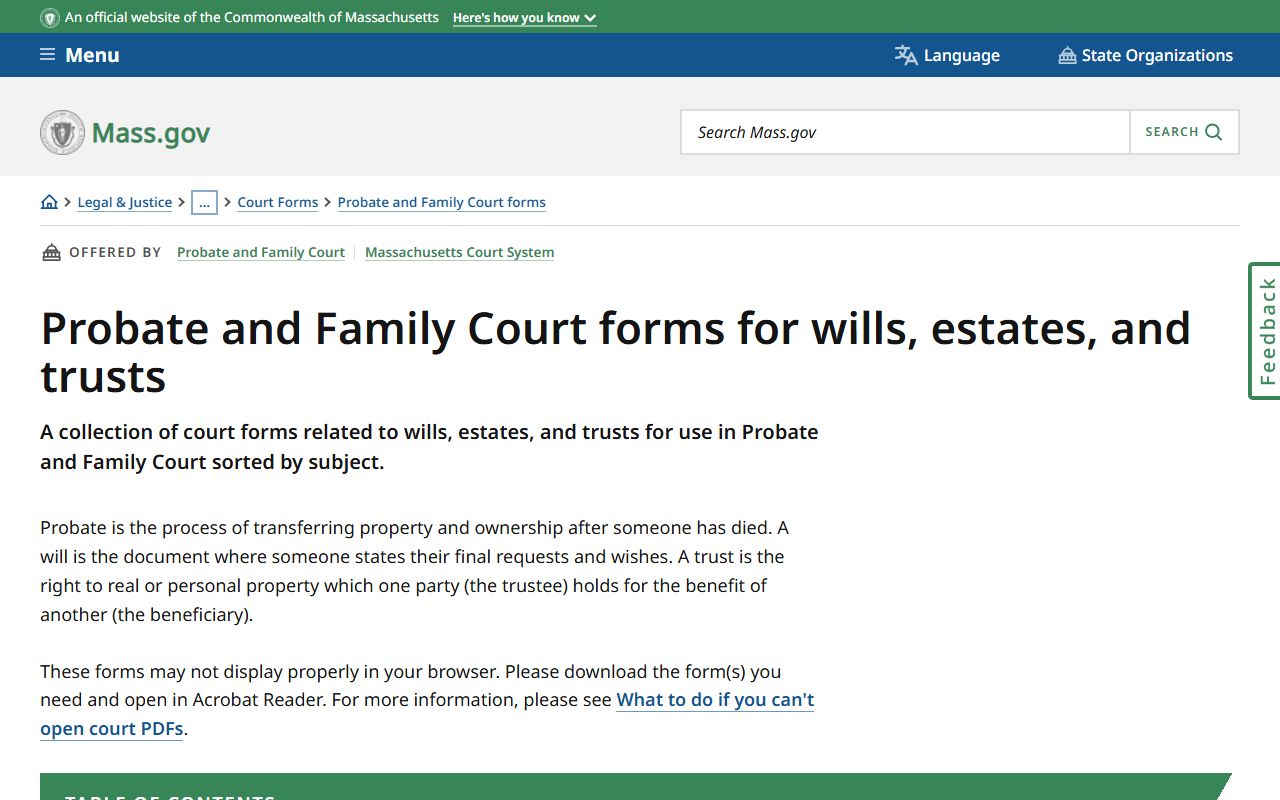
That forms page covers petitions, military affidavits, bond forms, inventory and account schedules, and trust-related filings used in Norfolk County estate cases.
- Decedent or estate name and docket number
- Case type (informal estate, formal estate, guardianship, conservatorship, trust, name change)
- Filing date and petitioner name
- Personal representative or guardian appointed
- Interested parties and their relationship to the estate
- Event log: petition filed, citation issued, bond filed, notice given, decree or order entered, letters issued, inventory filed, account filed, allowance, estate closed
- Documents: viewability in MassCourts varies; certified or official copies require a request to the Register's Office
- Restrictions: adoption records are sealed; guardianship medical information and impounded materials may be withheld from public access
Note: MassCourts provides docket-level information. The actual will, inventory schedule, and account documents are part of the court file and must be obtained from the Register's Office in Canton.
Restricted Probate Records in Norfolk County
Not all probate records are open to public inspection. Several categories are restricted by statute or court order, and the restrictions are strict.
Adoption records are the most complete restriction. Under M.G.L. c.210, section 5C, adoption petitions, reports, pleadings, papers, docket entries, permanent docket books, and indexes are not available for inspection unless a probate judge orders access for good cause. This applies to both old and new adoption cases. If you have a reason to seek access, you need to file a motion and demonstrate good cause to the court.
Guardianship and conservatorship records can include medical evaluations, capacity assessments, and treatment records tied to the protected person. Those materials are often impounded or restricted even when the basic docket is public. Court Rule VIII governs impoundment procedure, and specific guardianship statutes add additional protections for persons who are incapacitated.
Financial statements filed in certain family matters within the Probate and Family Court are also restricted. They are accessible to the parties and their attorneys but not to the general public. This matters for any estate case that also involves an ongoing family dispute or a pending financial proceeding.
If a case cannot be found through MassCourts, it may be impounded, restricted, or simply not yet indexed electronically. The Register's Office at 781-830-1200 can confirm whether a case exists and what access rules apply.