
The Massachusetts Public Records Law
Massachusetts public-records access is governed by two General Laws statutes that work together. The first is M.G.L. c.66, §10, which creates the right to inspect or copy public records. It requires the records access officer of any agency or municipality to respond to a request without unreasonable delay and, in most cases, within 10 business days. The second is M.G.L. c.4, §7, cl.26, which defines what a public record is and lists the categories of information that can be withheld.
Anyone can make a public-records request. You do not need to be a Massachusetts resident. You do not need to explain why you want the records. A request can be verbal, made in person, or submitted in writing, but a written request is important if you think you may need to appeal a denial later. The Secretary of the Commonwealth strongly recommends written requests for that reason.
The law covers state agencies and municipalities. It does not override court-specific confidentiality rules, impoundment orders, juvenile access restrictions, CORI law, or adoption statutes. Court case files, dockets, and certified copies are governed by the Trial Court's own uniform rules, not by the Public Records Law. If you need a court document, the right office is the clerk or register where the case was filed, not a public-records request to the agency level.
The official Secretary of the Commonwealth guide to public records requests is the clearest starting point for understanding what to expect from an agency.
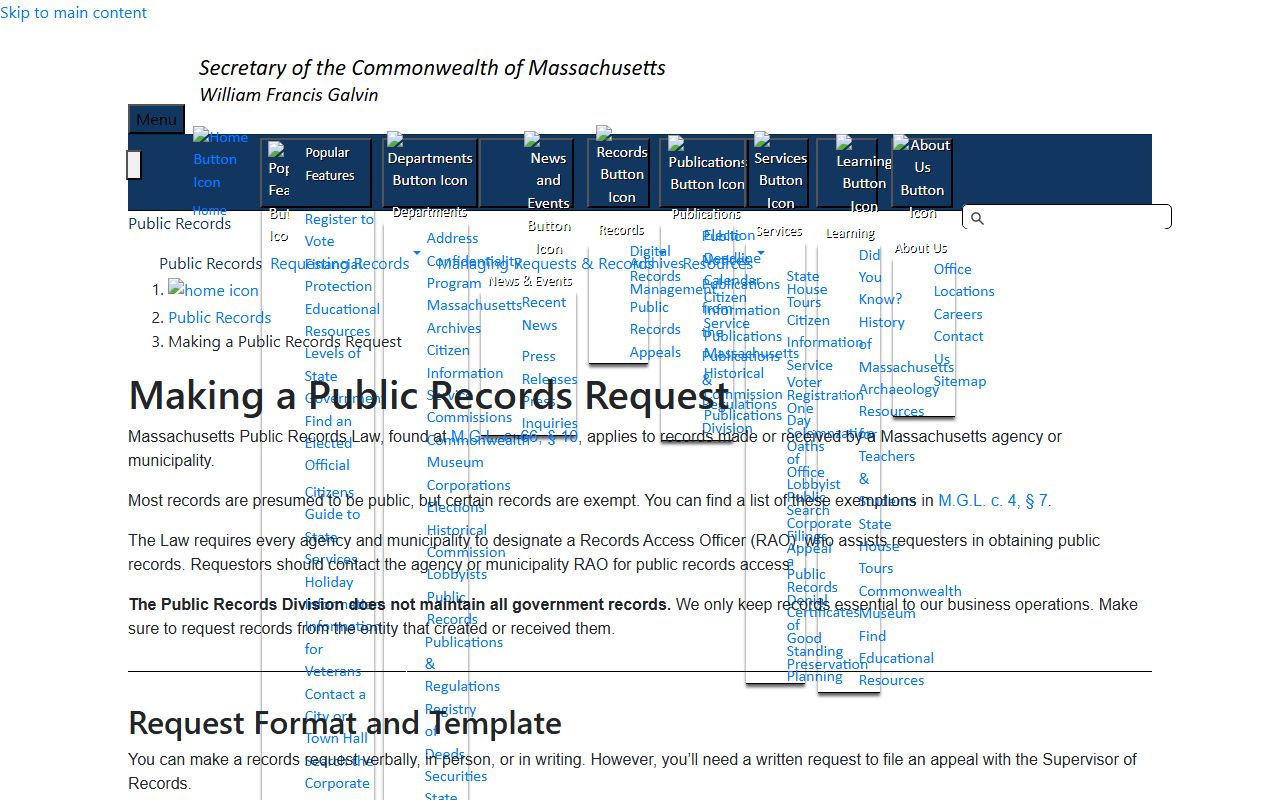
The Secretary's office also oversees the Supervisor of Records, who handles appeals when agencies deny or ignore requests.
What Norfolk County Public Records Cover
Norfolk County does not have a single countywide clerk who holds all records. Clerk functions are split among agencies and offices depending on record type. The Registry of Deeds holds land records. City and town clerks hold vital records. The Sheriff and District Attorney maintain their own administrative files. Municipal police departments keep arrest reports and incident records. Understanding where each record lives determines which office gets your request.
The Norfolk County Registry of Deeds is the primary non-court public-records source for the county. It maintains recorded and registered land documents for all 28 cities and towns. Deeds, mortgages, mortgage discharges, homestead declarations, liens, and plans are recorded there and are fully open to the public. Land records are searchable online through the Registry website and are accessible in person at the Dedham office.
- Registry of Deeds: deeds, mortgages, homestead declarations, liens, plans, registered land documents
- City and town clerks: birth, marriage, and death certificates; local bylaws; meeting minutes; licenses
- Norfolk County Sheriff: administrative policies, budgets, contracts, audit responses, non-confidential operational records
- Norfolk District Attorney: press releases, public case summaries, non-investigatory administrative records
- Municipal police departments: arrest reports, incident reports, police logs (subject to ongoing-investigation and privacy limits)
- Registry of Motor Vehicles: driver records governed by the federal Driver Privacy Protection Act
Note: RMV driver records are regulated by both state RMV procedures and federal Driver Privacy Protection Act rules. A court traffic docket from MassCourts is a separate record from a true-and-attested RMV driving history.
Norfolk Registry of Deeds Land Records
The Norfolk County Registry of Deeds is one of the most-used public-records sources in the county. It records and maintains land documents for Norfolk County's 28 cities and towns under the Massachusetts recording system. The Registry handles both recorded land (the older, deed-based system) and registered land (the Torrens title-certificate system). Each system has its own recording procedures and fee schedule. For most residential real-estate transactions in Norfolk County, the Registry is the place to look for ownership history, mortgage status, and encumbrances.
Records available at the Registry include deeds, mortgages, discharge of mortgages, declarations of homestead, attachments, federal and state tax liens, notices of lis pendens, plans, and Land Court documents. The Registry's online search tool at norfolkdeeds.org lets you search by grantor, grantee, address, and book/page reference. In-person research terminals are also available at the Dedham office, which shares the High Street civic campus with the Superior Court.
The Registry's online research application lets approved users access and print official images. The form captures account information before access is granted. Below is the field inventory from the Norfolk Registry Online Research Application.
| Field Label | Type | Notes |
|---|---|---|
| Name / firm applicant | Text | Account applicant identity; individual or firm name. |
| Address | Text | Mailing or contact address for the account holder. |
| Telephone / fax / email | Text | Contact fields for Registry communications. |
| User names / authorized users | Text | Lists who may access the account for internet research. |
| Signature / date | Signature and date | Required when submitting; acknowledges application terms and fee agreement. |
| Payment | Instruction | Registry accepts payment per the fee schedule; printing official images costs $1 per page. |
The Registry is separate from the Trial Court. Its records are not court dockets and are not searched through MassCourts. A deed search at the Registry will not show you a court judgment. A court records search through MassCourts will not show you a deed.
The official Registry website is shown below, captured from norfolkdeeds.org.
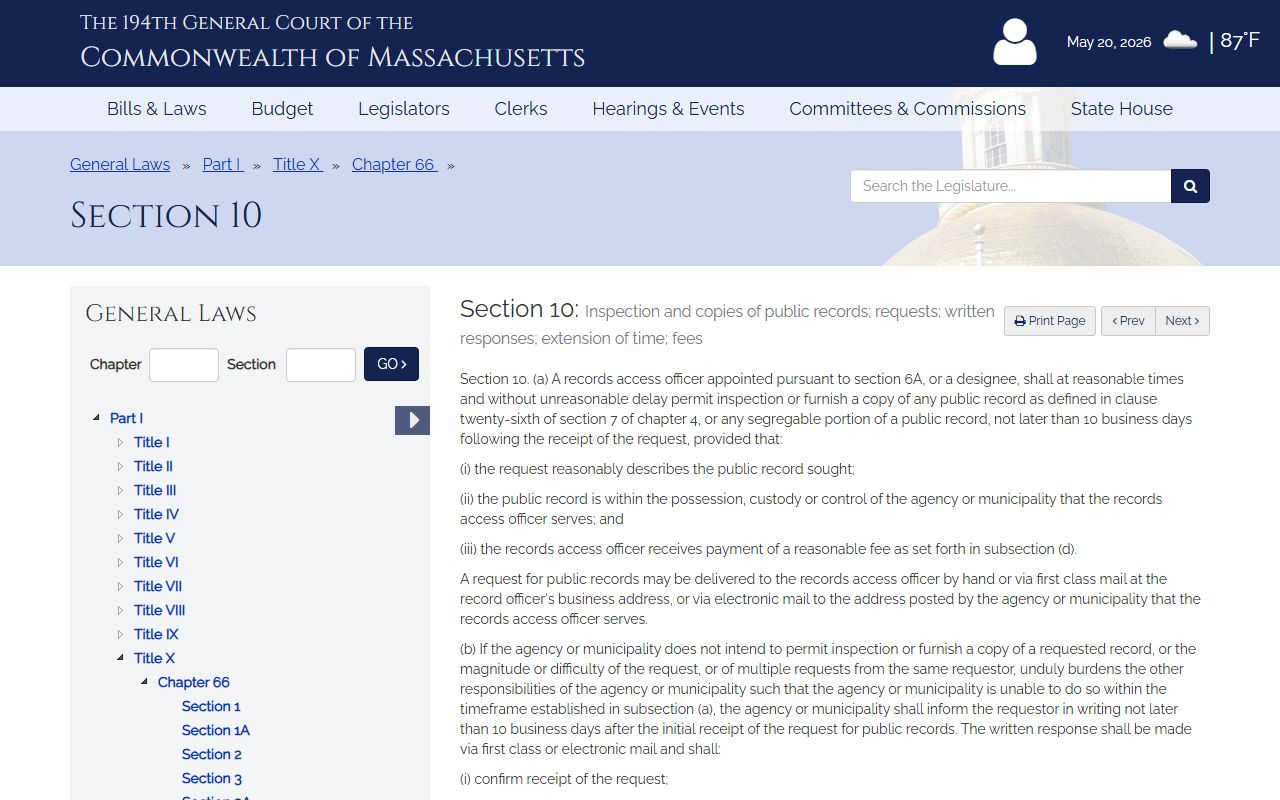
The statute shown above, M.G.L. c.66, §10, is the foundation of every public-records request made to a Norfolk County agency or municipality.
How to File a Norfolk County Public Records Request
The request process is the same for most Norfolk County agencies and municipalities. Every public agency in Massachusetts must designate a records access officer (RAO) to receive and process requests. You direct your request to the RAO of the office that holds the records. If you are not sure which agency has the records, start with the most likely custodian and ask. The Secretary of the Commonwealth guide recommends written requests over verbal ones so you have a clear starting point if an appeal becomes necessary.
- Identify the right office. Determine which agency or municipality holds the records you want. Land records go to the Norfolk Registry of Deeds. Police reports go to the municipal police department. Sheriff administrative records go to the Norfolk County Sheriff's Office. Vital records (birth, marriage, death) go to the city or town clerk that issued them. Court case files go to the clerk or register of the court where the case was filed, not to an agency RAO.
- Describe the records clearly. Write a description specific enough for the RAO to locate them. Include date ranges, names of parties or subjects, document types, or case or reference numbers where known. The agency does not need to create records or answer questions; it must produce existing records that match your description.
- Submit your request in writing. You can send a written request by email, mail, or in person. Address it to the records access officer of the specific office. No special form is required under state law, but many agencies post their own request forms on their websites. A written record is essential if you may later file an appeal with the Supervisor of Records.
- Wait for the response. The agency must respond within 10 business days under M.G.L. c.66, §10. It may grant access, provide copies, deny the request with a written explanation citing exemptions, or notify you that additional time is needed. An extension is allowed when the volume or complexity of the request warrants it, but the agency must notify you of the reason and the extended date.
- Pay any fees and receive the records. If fees apply, the agency will tell you the amount before producing the records. You pay first; then records are released. For electronic copies, fees are often lower than for paper copies. If the agency denies access to some records but not others, it must segregate and produce the portions that are public.
- Appeal if needed. If you disagree with a denial or the agency does not respond within the deadline, you can file a complaint with the Supervisor of Records through the Secretary of the Commonwealth's office. The Supervisor can order the agency to produce records. You can also go to Superior Court if the administrative route does not resolve the dispute.
Public Records Fees in Norfolk County
Fees under the Massachusetts Public Records Law are set by M.G.L. c.66, §10. Agencies may charge for the actual cost of reproducing records. For paper copies, the standard rate is generally $0.05 per page for black-and-white copies; however, agencies can charge more if they can justify the cost. Labor charges may apply when the search, compilation, or segregation of records takes more than two hours. Electronic records are often provided for free or at low cost. The Secretary of the Commonwealth publishes current fee guidance on its public-records page.
Registry of Deeds recording and copy fees are set separately from the Public Records Law fee schedule. The Registry charges based on document type and land system (recorded or registered land). The fee schedule below reflects the Norfolk Registry's published rates.
| Item | Recorded Land | Registered Land |
|---|---|---|
| Recording a deed | $156 | $155 |
| Recording a mortgage | $206 | $205 |
| Recording a declaration of homestead | $36 | $35 |
| Copies ordered by mail | $1 per page + $1 postage per document | $1 per page + $1 postage per document |
| Online image print (official/non-watermarked) | $1 per page | $1 per page |
These rates come from the Norfolk Registry of Deeds fee schedule and the Registry's online research guide. Confirm current fees before submitting payment, as schedules may be updated.
Court filing fees and certified copy fees are charged separately by the clerk or register of each Trial Court department. For example, the Probate and Family Court has its own filing schedule. For court-document copy fees, contact the specific clerk's office directly.
Note: Fee waivers for public-records requests are available to indigent requesters and members of the news media under the statute; contact the agency RAO for waiver procedures.
Records That May Be Withheld
Not every record held by a Norfolk County agency is open to the public. M.G.L. c.4, §7, cl.26 lists the exemption categories that allow agencies to withhold or redact information. The exemptions are not all-or-nothing. When only part of a record is exempt, the agency must produce the rest, with the exempt portion redacted rather than the whole document withheld. Agencies must cite the specific exemption when denying access to any portion of a record.
Common exemptions that arise in Norfolk County requests include:
- Privacy exemption: Personal information whose release would constitute an unwarranted invasion of personal privacy. Applies frequently to personnel files, medical information, and personal identifying data.
- Investigatory exemption: Records compiled for law-enforcement purposes that could interfere with an ongoing investigation, reveal sources, or endanger individuals. Police and DA records often fall here for active matters.
- Personnel and medical exemption: Employee personnel files and individually identifiable medical records are protected.
- Attorney-client / deliberative process: Internal agency communications, legal advice, and pre-decisional deliberative materials may be withheld.
- Statutory confidentiality: Records that another law specifically declares confidential, such as juvenile records under M.G.L. c.119, adoption records under M.G.L. c.210, sealed criminal records under M.G.L. c.276, and CORI records under M.G.L. c.6.
Sheriff records on inmate medical care, security classifications, and victim information are commonly redacted or withheld. Norfolk DA prosecution files may include investigatory, grand-jury, victim/witness, and attorney-work-product materials that are protected. Police logs and arrest reports that are public can still carry redactions for victim identity, minor information, or ongoing-investigation material.
The exemption definition statute is shown in the image below, taken from the Massachusetts Legislature's official page for M.G.L. c.4, §7.
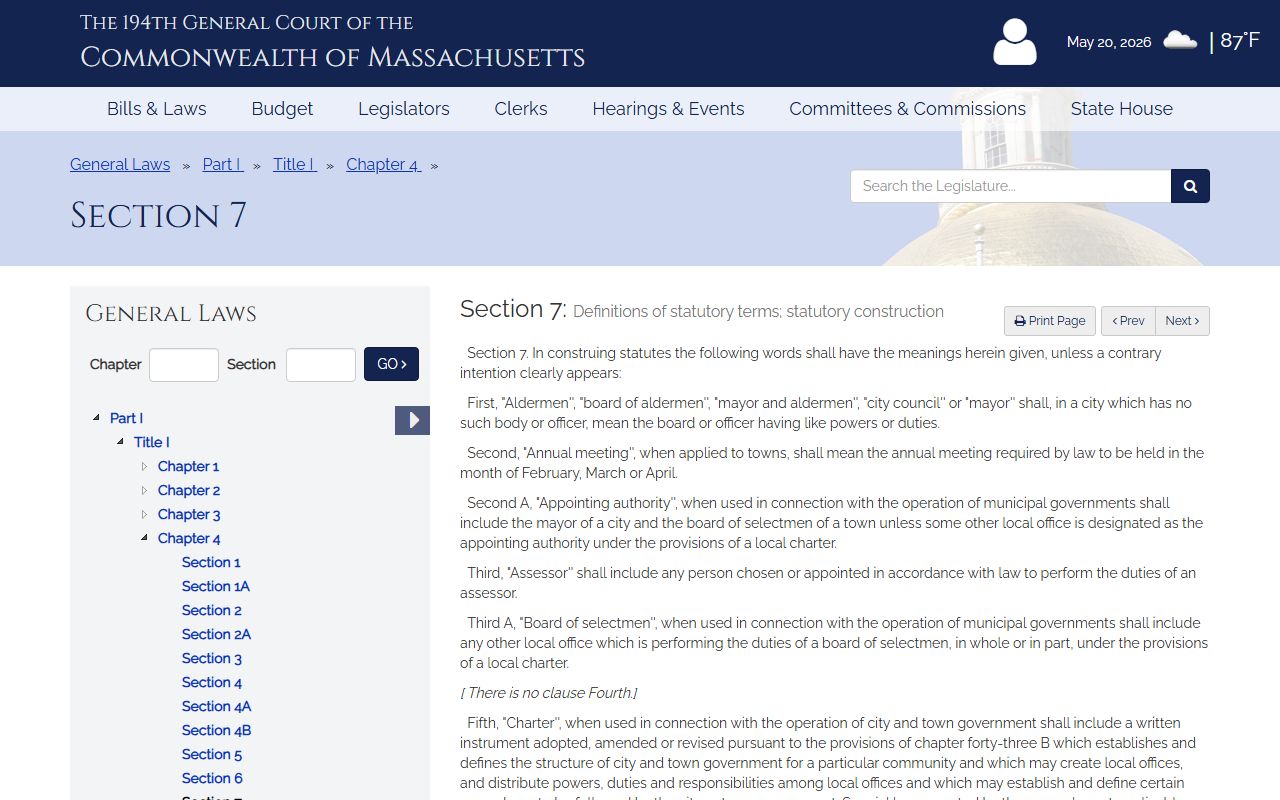
Understanding which exemption applies is key to deciding whether an appeal is worth pursuing; the Supervisor of Records can review whether the agency's claim is valid.
Court Files vs. Agency Public Records
Court records in Norfolk County follow a different set of rules than agency public records. The Trial Court's Uniform Rules on Public Access to Court Records, known as Trial Court Rule XIV, govern what the public can see from clerk and register offices. These rules are separate from the Public Records Law. A request to inspect a Superior Court docket, a Probate and Family Court estate file, or a District Court criminal docket is not a "public-records request" under M.G.L. c.66. It is a request to the clerk or register under the Trial Court's own access framework.
The practical difference matters. A denied or delayed court-record request does not go to the Supervisor of Records for appeal. The avenue for contesting court-record access decisions is typically a motion or rule-based request within the court system itself. If you want a certified copy of a judgment, a divorce decree, a probate inventory, or a Superior Court decision, contact the appropriate Norfolk clerk or register:
- Superior Court civil and criminal files: Clerk of Courts Walter F. Timilty, 650 High Street, Dedham, 781-326-1600
- Probate and Family Court: Register Colleen Brierley, 35 Shawmut Road, Canton, 781-830-1200
- District Court cases: the Clerk-Magistrate at the specific District Court division that handled the case
For online docket access, court records can be searched through the MassCourts eAccess portal. The portal shows docket entries and some case information, but it is not a certified-copy system. Certified copies require contact with the filing office. See the Clerk of Court page for more on how to request certified documents.
Appealing a Denied Request
If a Norfolk County agency denies your public-records request or does not respond within 10 business days, you have two main options. The first is to file a complaint with the Supervisor of Records, who is part of the Secretary of the Commonwealth's office. The Supervisor can review the agency's response, order disclosure if the exemptions claimed are not valid, and impose remedies for noncompliance. The enforcement statute is M.G.L. c.66, §10A, which provides the review and enforcement structure for agency-level public-records disputes.
The appeal to the Supervisor is an administrative route. It works best for clear cases where an agency has refused a request, cited an exemption without explanation, or simply failed to respond at all. A written request is required before filing an appeal, because the Supervisor reviews the record of what was asked and what the agency said. This is the main practical reason the Secretary's guide recommends written requests from the start.
The second option is a civil suit in Superior Court. A requester who prevails in court can seek an order compelling disclosure and may also recover attorney's fees and costs. The court route takes longer and costs more, but it may be the only effective path when an agency is unresponsive to the Supervisor's process or when the records have significant legal value. Norfolk County Superior Court would be the appropriate venue for such an action.
For court-file access disputes, the process is different. Those go through a motion or formal written request to the court under Trial Court Rule XIV, not through the Supervisor of Records. The Probate Records and Court Records pages cover the court-specific request process in more detail.
Sheriff and DA Administrative Records
The Norfolk County Sheriff's Office and the Norfolk District Attorney's Office are public agencies subject to the Public Records Law for their administrative records. Budget documents, contracts, organizational policies, press releases, and other non-confidential materials can be requested through each office's records access officer. Both offices have exemptions that routinely apply to some of their records, but that does not mean every record they hold is off limits.
Sheriff administrative records that are frequently public include operational budgets, staffing and organizational charts, general policies not tied to security vulnerabilities, public reports, and responses to oversight audits. The State Auditor's office has published reports on the Norfolk County Sheriff, including a 2024 audit of healthcare and inmate deaths. Those audit reports are themselves public documents available directly from the State Auditor. Records that are typically withheld or redacted include inmate medical files, security and classification details, victim information, and CORI-protected criminal history.
Norfolk DA administrative records follow a similar pattern. The DA's office releases press releases, public summaries of major cases, and general administrative information. Prosecution files, grand-jury materials, victim and witness identifying information, investigatory work product, and CORI records are protected. The Norfolk District Attorney's Office page on Mass.gov provides contact and public information.
Police incident reports and arrest logs at the municipal level vary by city and town in Norfolk County. Each of the 28 cities and towns in the county has its own police department. Each department has its own RAO. Public police logs are generally available, but ongoing investigations, victim information, and juvenile-related records are commonly redacted or withheld under the investigatory and privacy exemptions. For arrest and criminal data, also see the arrest records page.