
Active Warrants in Norfolk County
Warrants in Norfolk County are issued by Massachusetts courts. The Norfolk County Superior Court in Dedham, the five District Court divisions serving the county's cities and towns, and the Norfolk Probate and Family Court in Canton can each issue warrants. A judge or clerk-magistrate signs a warrant and enters it into court and law-enforcement tracking systems. Which court holds the record depends entirely on the case type. A felony arrest warrant will sit in Superior Court records. A default on a misdemeanor charge, a civil contempt capias, or a probation detainer may sit in a District Court file or Probate and Family Court file.
No official public Norfolk active-warrant list was located during research. The Norfolk County Sheriff's Office does not publish a searchable warrant database on its website. Massachusetts warrants are tracked through the state court system and the Criminal Justice Information Services network. They are not posted on a county web page the way some states publish daily warrant lists. If you want to know whether a warrant exists, the best steps are to search Massachusetts Trial Court Case Access (MassCourts eAccess) for the underlying case, call the clerk's office at the relevant court, or speak with a defense attorney. Do not rely on third-party warrant sites that are not run by official Massachusetts agencies.
The Massachusetts Trial Court manages warrant data under M.G.L. c. 276, § 23A, which sets out required fields for the statewide warrant management system. That statute specifies what information must be included when a warrant is entered into the system. It does not create a public-facing web search tool. The data goes to authorized law-enforcement channels and is used to execute the warrant when a person is located.
The Norfolk District Attorney's Office prosecutes criminal offenses in the county's 27 cities and towns. DA Michael W. Morrissey's office works with the District Court and Superior Court on criminal cases, including cases where a default or arrest warrant has been issued. The DA does not maintain a public warrant search tool either. Warrant status is a court and law-enforcement record, not a DA public disclosure.
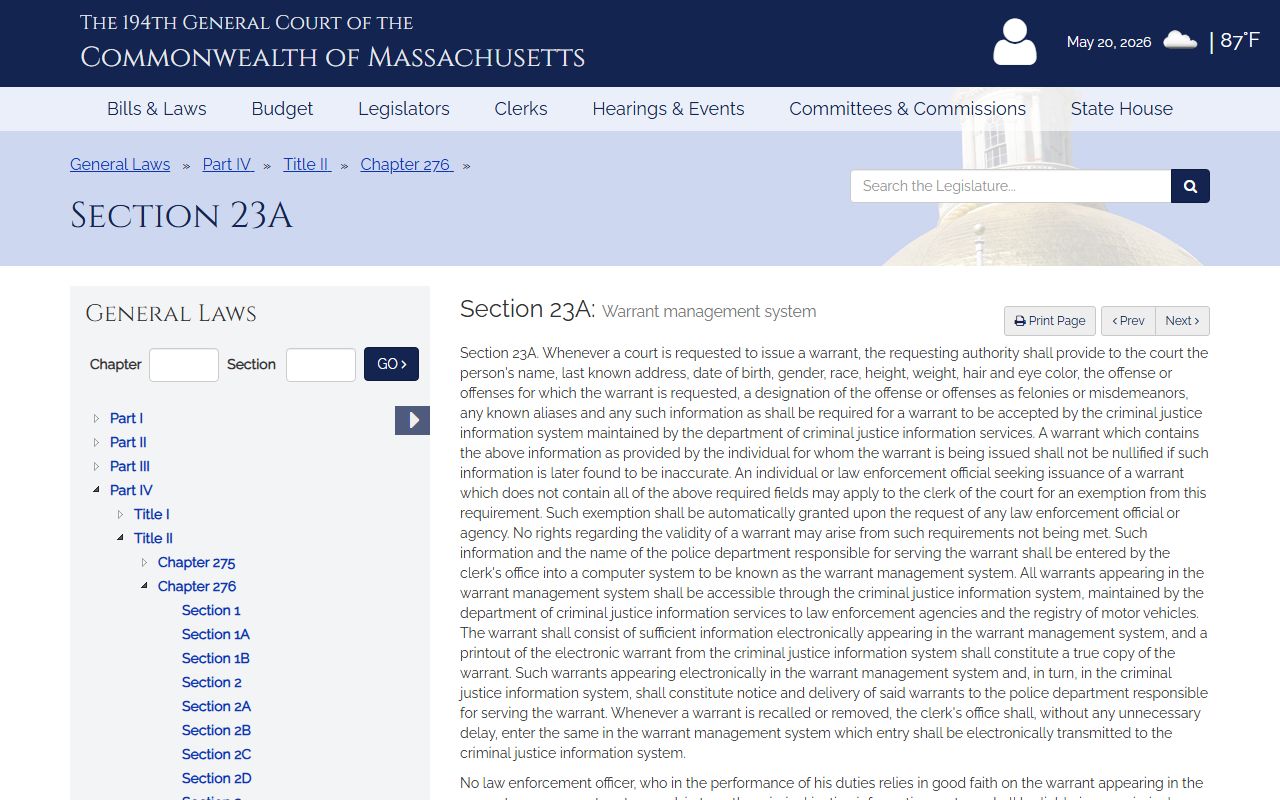
The Massachusetts Legislature's page for M.G.L. c. 276, § 23A shows the warrant management statute that governs required data fields for Norfolk County and all Massachusetts warrants entered into the statewide system.
Types of Norfolk County Warrants
Massachusetts courts issue several distinct warrant types. Knowing which type may be involved helps narrow where to look and what to expect. An arrest warrant and a bench warrant are not the same thing, though both can result in detention. A search warrant is different again; it does not target a person for arrest but authorizes officers to search a location or seize property. Each type goes through a specific court process and is tracked by the issuing court.
- Arrest warrant - Issued when a court finds probable cause that a person committed a crime and authorizes law enforcement to arrest them and bring them before the court.
- Bench/default warrant - Issued from the bench when a person fails to appear for a scheduled court date or fails to comply with a court order; also called a default warrant when the person defaults on an appearance.
- Search warrant - Authorizes law enforcement to search a specific place, person, or property for evidence; the supporting affidavit may be impounded while the investigation is active.
- Probation warrant/detainer - Issued for an alleged violation of probation conditions; the probation officer petitions the court, which may issue a warrant to bring the person before a judge for a surrender hearing.
- Capias - A civil process to bring a person before the court; used in certain noncriminal contexts where a person has failed to comply with a civil court order.
- Fugitive/extradition warrant - Handles out-of-state warrant situations under interstate rendition law; if another state seeks a person found in Massachusetts, a governor's warrant may be issued.
Bench warrants and default warrants are issued often. Missing a District Court date in Dedham, Quincy, Brookline, Stoughton, or Wrentham can result in a default warrant the same day. The warrant sits in that court's record. The best way to confirm whether a default has been entered is to call the specific Clerk-Magistrate's office for that court division. Once a default warrant is entered, the case may be suspended until the person appears or is brought in.
Note: Search warrants are the type least accessible to the public. A search warrant's supporting affidavit is often sealed under Trial Court impoundment rules while the investigation proceeds.
How to Check for a Norfolk County Warrant
Because no official public Norfolk active-warrant portal exists, checking for a warrant requires going to the source courts and official systems. The steps below reflect what is available to the public through official Massachusetts channels. They are practical and direct. If a case already exists in MassCourts, the docket may show a default or warrant entry. If no case exists yet, the warrant may not be findable online at all and a call to the clerk is the only way to get information.
- Go to the MassCourts eAccess portal at www.masscourts.org. Check the "I'm not a robot" checkbox, then click the button to enter public records.
- Choose the court department you believe is involved. Select District Court if the matter is a local criminal case, traffic citation, or misdemeanor. Select Superior Court for felony matters. Select Probate and Family Court for civil contempt or family-matter capias situations.
- Choose the Norfolk County location for the division you suspect. Norfolk County District Courts are Brookline, Dedham, Quincy, Stoughton, and Wrentham. Superior Court location is Norfolk. Probate and Family Court location is Norfolk.
- Use the Case Number tab if you have a docket number. This is the most reliable method. Case-number searches require exact capitalization, spacing, and leading zeros as they appear on any court paperwork you received.
- If you have no docket number, use the Name tab for civil matters or the Case Type tab for a date-range search. Be aware that the Name tab is for civil cases only according to the Mass.gov guide. Criminal case name searches may not return results this way.
- Look for docket entries showing "default," "warrant issued," or related entries. If those entries appear, contact the Clerk-Magistrate's office for that court directly to ask about the current status and what steps are needed.
- If you cannot find a case online or you need confirmation, call the clerk at the court you believe issued the warrant. For Superior Court, the Clerk of Courts office in Dedham can be reached at 781-326-1600. For each District Court division, use the Clerk-Magistrate's direct number.
Speaking with a defense attorney is strongly recommended before taking any action if you believe a warrant exists in your name. An attorney can do a more thorough check and advise you on how to address the warrant without unnecessary risk.
Norfolk County Warrant Management Fields
Massachusetts law under M.G.L. c. 276, § 23A sets out what information must be included when a warrant is entered into the statewide warrant management system. These are the fields required when a requesting authority submits a warrant for entry. Law enforcement uses these fields when attempting to identify and execute a warrant. Members of the public do not have direct access to the warrant management system, but knowing these fields explains what information courts and police work from when a warrant is active.
| Field | Required by Statute | Notes |
|---|---|---|
| Person's name | Yes | Required for every warrant entry under § 23A. |
| Last known address | Yes | Required. |
| Date of birth | Yes | Required to distinguish individuals with similar names. |
| Gender | Yes | Required. |
| Race | Yes | Required. |
| Height | Yes | Required physical descriptor. |
| Weight | Yes | Required physical descriptor. |
| Hair color | Yes | Required. |
| Eye color | Yes | Required. |
| Offense(s) | Yes | The specific offense or offenses for which the warrant was requested. |
| Felony/misdemeanor designation | Yes | Required designation for each offense listed. |
| Known aliases | Yes, if known | Included in the statute when aliases are known to the requesting authority. |
| CJIS-required information | Yes | Additional Criminal Justice Information Services fields required for system compatibility. |
These fields are for internal law-enforcement and court use. A public court docket will show some related information, such as the charges and the warrant event, but may not display all physical descriptor fields. Safety and privacy rules govern what appears publicly versus what stays within law-enforcement channels.
What a Norfolk County Warrant Record Shows
When a warrant appears in MassCourts or is confirmed by a clerk, the public-facing information is drawn from the underlying court case record. The full warrant management record includes more detail than what a public portal displays. The table below reflects what a typical public warrant-related court record may show, based on the statutory fields and standard court record practices in Massachusetts. Not every field will appear on every record; restrictions depend on the case type, impoundment orders, and whether the matter involves sealed or confidential information.
| Field | What It Shows |
|---|---|
| Person's name | Full name as entered on the warrant; aliases may be included. |
| Date of birth | Used to confirm the person's identity and distinguish between individuals with similar names. |
| Offense(s) | The charge or charges for which the warrant was issued, including statute reference. |
| Felony/misdemeanor designation | Shows whether the warrant relates to a felony or misdemeanor offense. |
| Issuing court | The specific court and division that issued the warrant, such as Dedham District Court or Norfolk Superior Court. |
| Warrant status | Active, recalled, or executed; status may not update in real time on the public portal. |
| Case/docket number | Links the warrant to the underlying criminal or civil case in the court's docket system. |
| Last known address | Required by § 23A but may not appear on public-facing court documents for privacy reasons. |
| Physical descriptors | Height, weight, hair color, eye color, race, gender; required by statute for law-enforcement use but often not in public docket view. |
| CJIS fields | Additional system fields required for cross-agency law-enforcement use; generally not visible to public searchers. |
How to Resolve an Outstanding Norfolk County Warrant
An outstanding warrant does not go away on its own. The longer it stays active, the greater the risk of an unexpected arrest, whether during a traffic stop, at work, at a courthouse for another matter, or at home. Courts in Norfolk County, as elsewhere in Massachusetts, can execute a warrant at any time once it is entered into the system. Taking action is almost always better than waiting.
Important: Speak with a defense attorney before contacting the court or turning yourself in; counsel can protect your rights and help arrange a favorable surrender time.
The following steps reflect the process for addressing an outstanding warrant through Norfolk County courts and the Massachusetts criminal justice system.
- Do not use third-party warrant sites as final authority. They may be outdated, inaccurate, or missing records entirely. Use official sources.
- Identify the likely court. If the case is a misdemeanor or local criminal matter, find the District Court division whose service area covers the city or town where the alleged offense occurred. Brookline District Court, Dedham District Court, Quincy District Court, Stoughton District Court, and Wrentham District Court each serve different municipalities. Felony matters sit in Norfolk Superior Court at 650 High Street, Dedham.
- Search MassCourts eAccess by case number if you have one. Look for docket events showing a default or warrant entry and note the current status.
- Call the clerk or criminal clerk at the relevant court. For Norfolk Superior Court, call the Clerk of Courts at 781-326-1600. Each District Court division has its own Clerk-Magistrate line. Ask about the current case status and what the court requires to address the warrant. Be aware the clerk may direct you to appear.
- Contact a defense attorney or ask the court about appointed counsel if you are facing criminal charges and cannot afford a lawyer. Massachusetts uses the Committee for Public Counsel Services (CPCS) for indigent defense rather than a county public defender. Eligibility is determined by a judge at arraignment.
- If surrendering, ask counsel or the clerk about bail hours and arraignment timing. Norfolk County Correctional Center bail is generally processed between 4:30 p.m. and 9:30 p.m. on weekdays and noon to 9:30 p.m. on weekends and holidays, though you should confirm current times before relying on them.
- After the warrant is recalled or the case is resolved, confirm the court docket reflects the recall. Allow processing time for the change to flow through law-enforcement systems. A recalled warrant can take time to clear from active databases.
For civil contempt warrants or a capias issued in a Probate and Family Court matter, the steps are similar but the court is different. Contact Norfolk Probate and Family Court Register's Office at 781-830-1200 for probate and family matters. Their address is 35 Shawmut Road, Canton, MA 02021.
The Norfolk District Attorney and Warrant Cases
The Norfolk District Attorney's Office prosecutes criminal cases in the county's 27 cities and towns under Massachusetts law. DA Michael W. Morrissey leads the office. When an arrest warrant is issued, it typically means the DA has presented sufficient evidence to a judge or a grand jury returned an indictment. The DA's office does not operate a public warrant lookup. Its role is prosecution, not public record distribution.
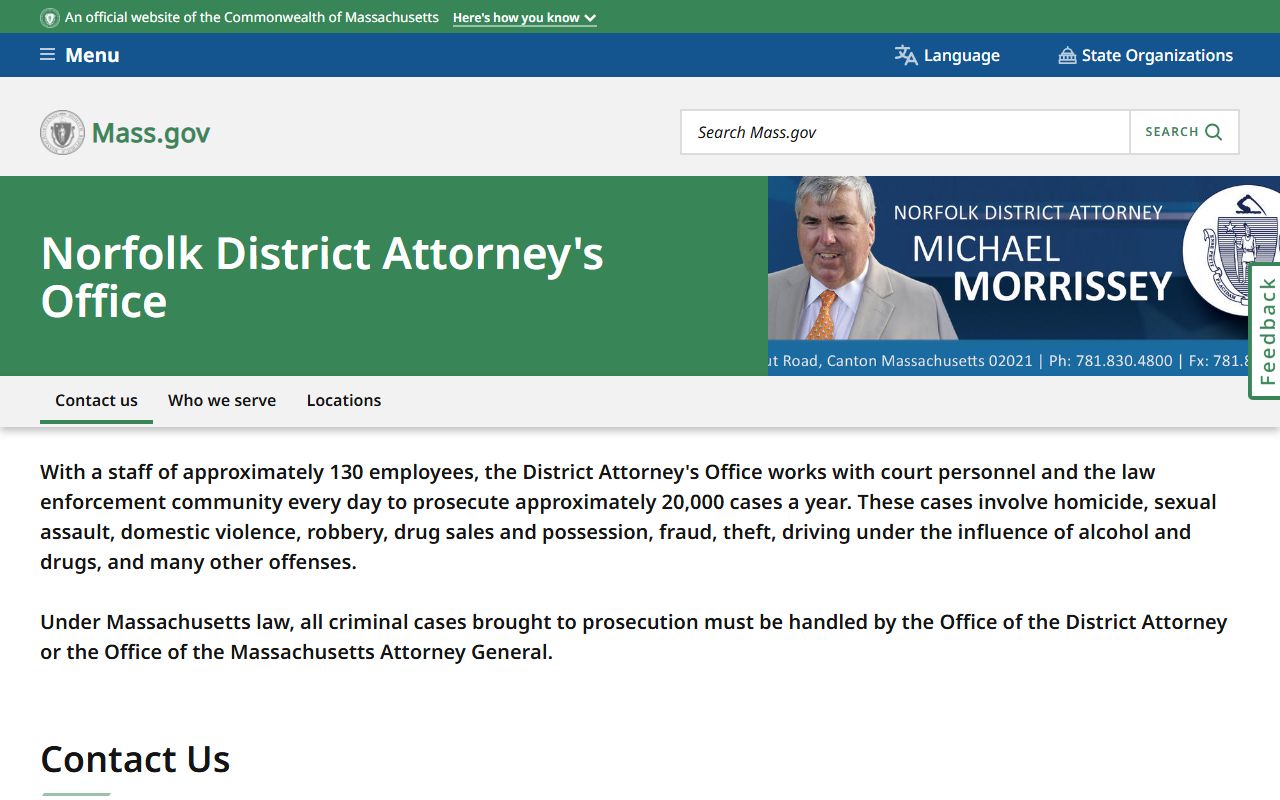
The Mass.gov page for the Norfolk District Attorney's Office is the official reference for the office's role in prosecuting Norfolk County warrant cases and criminal matters across the county's 27 municipalities.
If you are a victim or witness in a case where a warrant has been issued, the Norfolk DA Victim/Witness Assistance Program can provide support. A team of an Assistant District Attorney and a Victim Witness Advocate is assigned once a criminal case enters the system. For violent-crime victims, the Massachusetts Attorney General's Victim Compensation and Assistance Division can help with uninsured medical and mental-health costs and other losses. The DA's office can connect you with the right contact.
For cases that go to the grand jury in Norfolk Superior Court, the indictment process leads to an arrest warrant for the named defendant if they are not already in custody. Grand jury proceedings are secret until an indictment is filed and the warrant is executed or the defendant surrenders. After that point, the case becomes a public Superior Court record in Dedham.
Norfolk County Warrant Scam Warning
The Norfolk County Sheriff's Office has issued repeated warnings about a specific phone scam targeting Norfolk County residents. Callers claim to represent the Sheriff's Office or local police and tell the recipient that they missed jury duty or have an outstanding warrant. The caller then demands immediate payment to avoid arrest. These calls are fraudulent.
Important: Norfolk Sheriff McDermott has confirmed that his office and local police do not call residents to demand money for missed jury duty or outstanding warrants. If you receive such a call, hang up and report it.
The financial damage from these scams has been documented locally. In one case reported in May 2025, a Bourne resident lost $68,700 after believing a caller's claim of a contempt finding and arrest threat. Additional victims reported losses of $6,700 and $31,600 in October and November 2025 after similar calls. These are not small amounts. The scam is targeted and can be convincing because callers often know the victim's name and can reference local government offices by name.
Legitimate court and law-enforcement agencies in Massachusetts will not call you to demand payment over the phone to avoid arrest. If you have a real court matter involving a warrant, that process goes through court notices, written communications, and in-person court appearances. No court clerk or sheriff's deputy will ask for immediate wire transfer, gift cards, or cash over the phone as a way to recall a warrant.
If you receive a call like this, do not pay anything. Hang up. Then call the Norfolk County Sheriff's Office directly at 781-329-3705 or contact local police to report the attempt. You can also check the real status of any court matter through MassCourts or by calling the appropriate court clerk at a number you find through official Massachusetts government websites, not a number given to you by the caller.
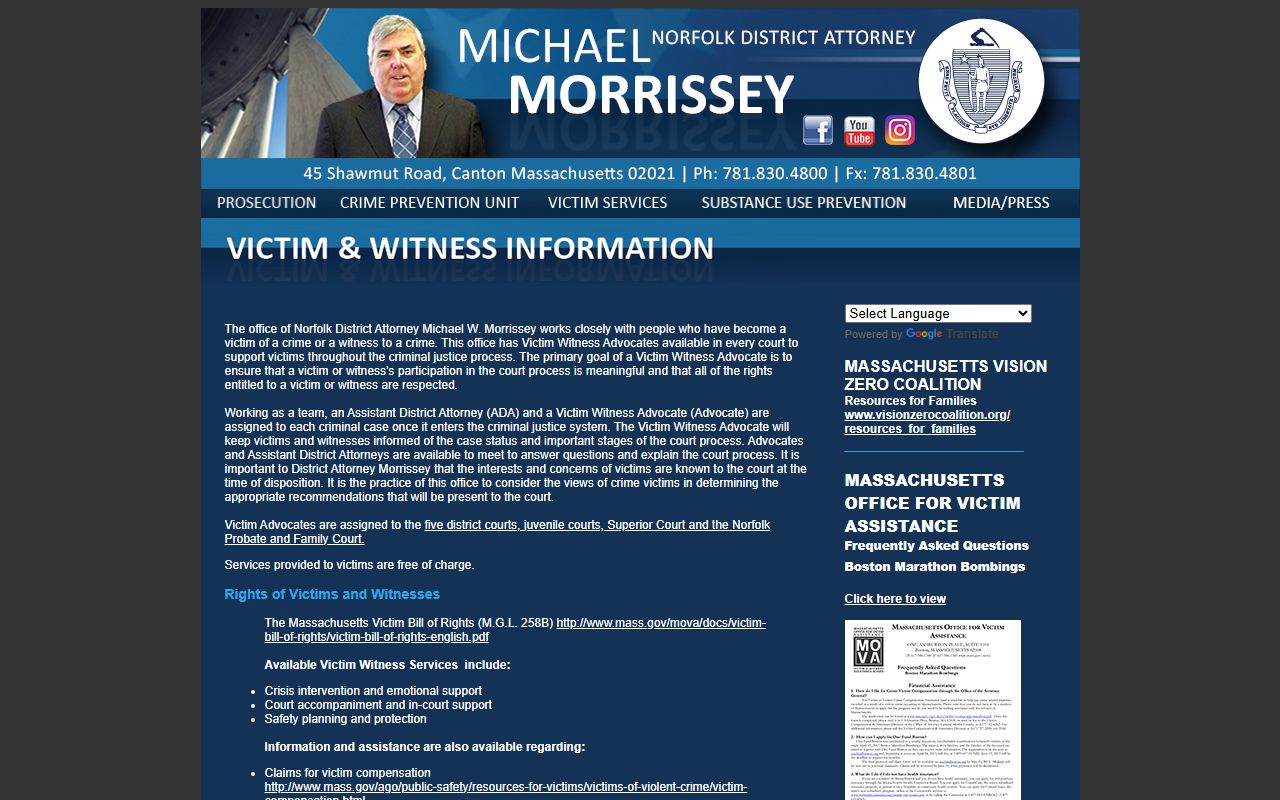
The Norfolk DA's Victim/Witness Assistance Program, shown on the nfkda.com site, can provide support to residents who have been victimized by scams connected to fraudulent warrant or jury-duty claims.
Restricted Norfolk County Warrant Records
Not all warrant information is public. Several categories of warrant records are restricted or impounded under Massachusetts law and court rules. Understanding these limits is important when you get little or no result from a court or online search.
Search warrants are the most commonly restricted type. The affidavit supporting a search warrant can be sealed under Trial Court Rule VIII (the Uniform Rules on Impoundment Procedure) while a criminal investigation is ongoing. The impoundment protects the investigation. Once the investigation concludes and the case is in open court, impoundment may be lifted, but the process requires a motion and a judge's decision. Even after a case is public, some affidavit details may remain sealed if they involve confidential informants or ongoing matters.
Juvenile warrants are restricted by statute. Delinquency records, including warrants issued in juvenile delinquency cases, are withheld from public inspection under M.G.L. c. 119, § 60A except for youthful offender indictment proceedings, which are treated like adult criminal records. If a juvenile matter is involved, the public docket will not show what a comparable adult matter would.
Warrants in sealed or expunged cases are not publicly available. If a criminal case was sealed under M.G.L. c. 276, §§ 100A or 100C, or expunged under § 100K, the associated warrant information would also be removed from public access. Sealed records can still be accessed by certain law-enforcement and judicial officials, but the public cannot.
Federal warrants are entirely separate. A federal arrest warrant issued by the U.S. District Court for the District of Massachusetts does not appear in MassCourts. Federal cases, including those involving Norfolk County residents, go through federal court systems. Use PACER at pacer.uscourts.gov for federal docket access. Federal grand jury warrants may remain under seal for extended periods.
Note: Warrants in active investigation cases may not appear in any public system until the matter becomes a public court proceeding.