
Marriage Licenses in Massachusetts
No Norfolk County office issues marriage licenses. In Massachusetts, the license comes from a city or town clerk, and the couple can apply at any city or town in the state. The clerk's office does not have to be in the town where either person lives or where the wedding will take place. That flexibility is useful if a couple lives in one part of Norfolk County but finds it more convenient to apply elsewhere. Both parties must appear together in person to complete the Notice of Intention of Marriage. The process is the same at every city and town clerk, though local fees and appointment rules differ.
Massachusetts sets a statewide minimum age of 18. No state residency is required of either party. After the couple files the Notice of Intention, there is a mandatory 3-day waiting period before the license is issued. A court can waive that wait in limited circumstances. Once issued, the license is valid for 60 days. The ceremony must happen within that window. After the wedding, the officiant signs the completed certificate and returns it to the city or town clerk that issued the license. The clerk then records the marriage and holds the official certificate on file.
The official Massachusetts marriage license guide on Mass.gov covers the full Notice of Intention process, acceptable proof of age, officiant rules, and what happens after the ceremony.
The guide is shown below, captured from Mass.gov.
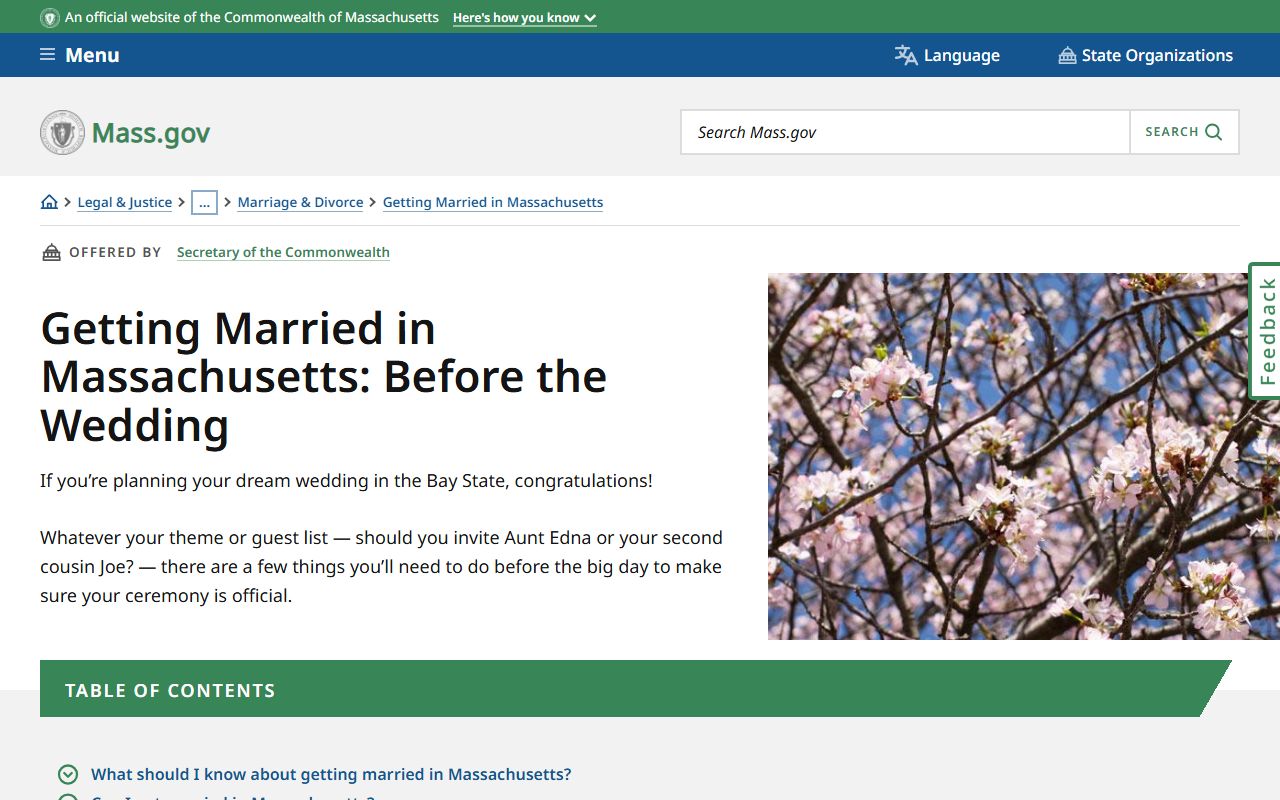
That same page answers common questions about name changes after marriage and what to do if the license expires before the ceremony.
Contact the city or town clerk where you plan to apply for local fees, hours, and appointment requirements. Norfolk County includes 28 cities and towns, each with its own clerk's office.
Note: Fees for a Massachusetts marriage license vary by city and town; there is no statewide fixed amount. Contact the clerk's office directly before your appointment.
How to Apply for a Marriage License
The process is straightforward but requires both people to appear at the same time. Before the appointment, confirm local hours and whether the clerk requires a scheduled time or accepts walk-ins. Bring original documents, not copies. The clerk will review them and complete the Notice of Intention form.
- Choose any Massachusetts city or town clerk's office. The location does not have to match either person's address or the wedding venue.
- Both parties appear together in person. One person appearing alone cannot complete the application.
- Bring proof of age, such as a birth certificate or passport. Massachusetts law requires verified identification showing you are at least 18.
- Provide legal names, current addresses, and details about the intended ceremony, including the proposed date and location. The clerk's form may also ask for the name each person will use after marriage.
- Give the name and contact information for the officiant. Clergy, justices of the peace, and certain one-day officiant designees are all recognized under Massachusetts law.
- Pay the local fee. The amount varies by city and town; confirm the amount before the visit.
- Wait the mandatory 3-day period unless a court grants a waiver. The license is then valid for 60 days.
- Hold the ceremony within the valid period. After the ceremony, the officiant returns the signed certificate to the issuing clerk.
If the 60-day window closes before the ceremony takes place, the couple must apply for a new license and pay the fee again. Plan the ceremony date carefully to avoid that situation.
Marriage License Application Field Inventory
The Notice of Intention of Marriage form collects specific information about both parties and the planned ceremony. Local clerk forms can vary slightly, but the core fields are consistent across Massachusetts. The table below reflects the standard requirements documented in the Mass.gov marriage license guide.
| Field / Requirement | Required | Notes |
|---|---|---|
| Both parties appear together | Yes | File Notice of Intention at any Massachusetts city or town clerk. In-person appearance by both is mandatory. |
| Proof of age | Yes | Examples include a birth certificate or passport. Must show both parties are at least 18. |
| Names of parties | Yes | Legal names as they appear on official identification. |
| Intended name after marriage | Often | Local clerk forms typically ask what name each person will use after the wedding. |
| Address / residence | Yes | Current address for each party. Residency in the town is not required. |
| Date and location of ceremony | Usually | Proposed wedding date and venue. Local forms vary. |
| Officiant information | Yes (before return of certificate) | Clergy, justice of the peace, or one-day designation. Officiant signs and returns the certificate after the ceremony. |
| Waiting period | Yes | 3 days after filing before the license is issued, unless a court grants a waiver. |
| License validity | Yes | 60 days from date of issue. Ceremony must occur within this window. |
| Fee | Yes | Varies by city or town. Confirm the amount with the local clerk before the appointment. |
How to Find Norfolk County Marriage Records
Marriage certificates are held by the city or town clerk that issued the license. If you need a certified copy of a marriage certificate for a wedding that took place in a Norfolk County city or town, contact the clerk for that specific municipality. That clerk keeps the official record on file. The fee and process for certified copies vary by town.
Massachusetts also maintains a statewide vital records archive through the Registry of Vital Records and Statistics, part of the Department of Public Health. Older marriage records, particularly those from many decades ago, may be accessible through the state registry even if the local town clerk no longer holds the file. The state registry holds records going back to 1926 and can supply certified copies for a fee. For records from before that period, the town clerk or a historical archive is often the better starting point.
To search for a recent marriage, contact the clerk for the town or city where the license was issued. If you are not sure which town handled the license, the state registry search or a request to the statewide vital records office may help locate the record. Neither a county clerk nor the Probate and Family Court holds marriage licenses or certificates. Those records do not route through court offices.
Norfolk County Divorce Records and Filing
Divorce in Massachusetts is handled by the Probate and Family Court, not by a county clerk or a separate family court. For Norfolk County, the court is Norfolk Probate and Family Court, located at 35 Shawmut Road, Canton, MA 02021. The Register's Office can be reached at 781-830-1200 or by email at norfolkprobate@jud.state.ma.us. Register Colleen Brierley oversees record-keeping for the court. Court hours are Monday through Friday, 8:30 a.m. to 4:30 p.m.
Massachusetts law gives the Probate and Family Court jurisdiction over all divorce cases. The court also handles custody, child support, alimony, separate support, and related family law matters. Divorce dockets are public records in most cases, but specific documents inside the file may be restricted. Financial statements filed during a divorce are not public. Materials related to minor children and any documents the court has impounded are also off-limits to general public access. The docket entries themselves, including case events and orders, are typically viewable through the MassCourts portal.
The official Massachusetts divorce guide on Mass.gov covers all three divorce types, required forms, the nisi period, and what to expect at each stage of the process.
That guide is shown below, captured from Mass.gov.
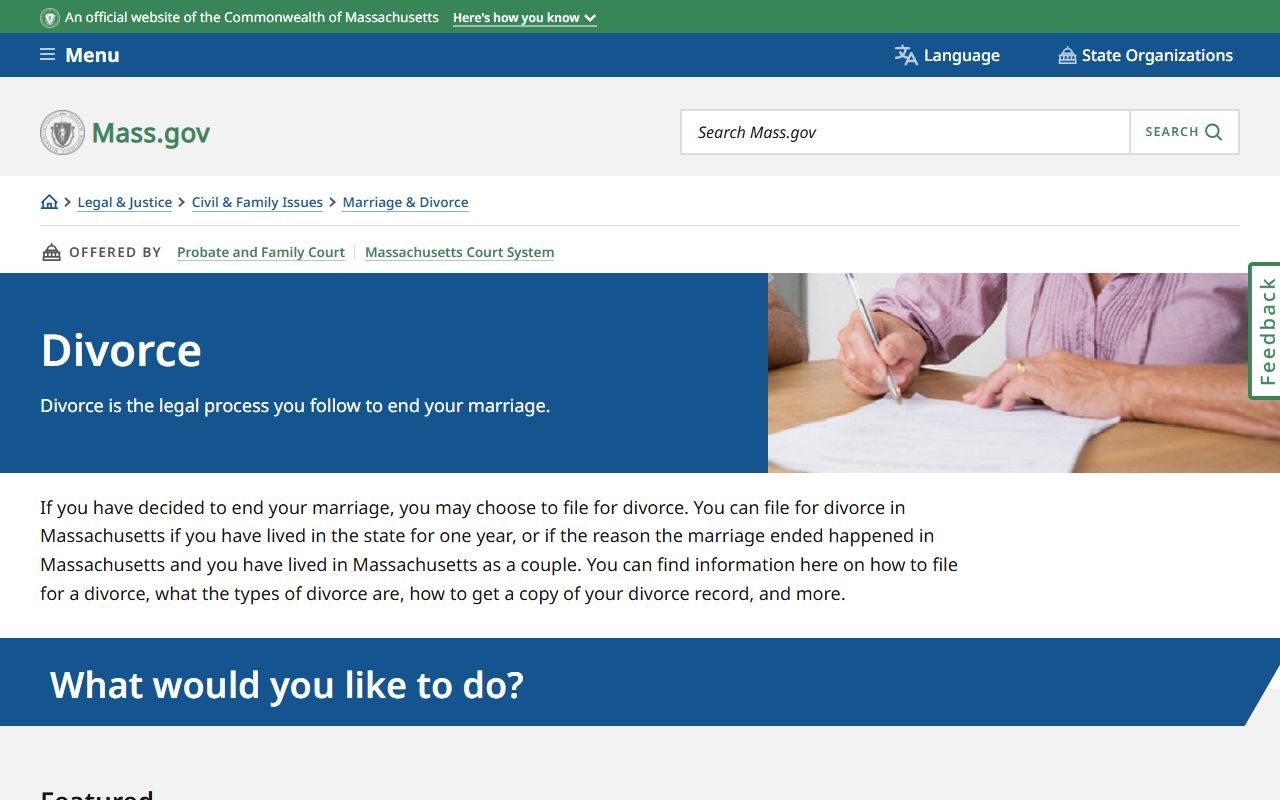
The Mass.gov divorce page also links to court forms, fee information, and self-help resources for people who are representing themselves.
Venue and Residency Rules: A person may file for divorce in Massachusetts if they have lived in the state for at least one year, or if the reason the marriage ended occurred in Massachusetts and both spouses lived in the state as a couple at that time. For venue within Massachusetts, file in the county where both spouses last lived together if one spouse still lives there. Otherwise, file in the county where either spouse lives now. For most Norfolk County divorces, that means Norfolk Probate and Family Court in Canton.
Types of Divorce in Massachusetts
Massachusetts recognizes three paths to divorce. The type you choose affects the forms you file, the process at the courthouse, and how long the case takes to finalize. Most divorces in Norfolk County fall under one of the two no-fault options.
- No-Fault 1A Divorce (Joint Petition)
- Both spouses agree that the marriage has broken down irretrievably and have reached a written separation agreement covering property, support, and, if there are children, custody and parenting time. Both spouses file together. The court holds one hearing. This is generally the fastest path when both sides agree on everything.
- No-Fault 1B Divorce (Complaint by One Spouse)
- One spouse files a complaint stating the marriage has broken down irretrievably, but the parties do not have a complete agreement. The other spouse is served with the complaint. The case may require hearings on contested issues. It takes longer than a 1A but still does not require proof of fault.
- Fault Divorce
- One spouse alleges specific statutory grounds such as adultery, desertion, cruel treatment, or gross intoxication. Fault divorces are less common. Proving fault grounds requires evidence and usually more court time. Massachusetts courts still apply equitable principles to property and support regardless of fault.
All three types end with a judgment of divorce nisi. The nisi period is a mandatory waiting period before the divorce is final. The length of the nisi period varies by divorce type. After the nisi period expires, the divorce becomes absolute. Only then is a person free to remarry.
Filing for Divorce at Norfolk Probate and Family Court
The steps below reflect the process described on the Mass.gov divorce page and the standard Probate and Family Court filing procedure. Before filing, gather all required documents. Missing forms or fees will delay the case.
- Determine venue. If one spouse still lives in the county where both last lived together, file in that county's Probate and Family Court. For most Norfolk County cases, that is Norfolk Probate and Family Court in Canton.
- Choose the divorce type: 1A joint petition, 1B complaint, or fault divorce. The type determines which forms you need.
- Gather required documents. For a 1A: the joint petition, a certified copy of the marriage certificate, a signed separation agreement, and financial statements for both parties. For a 1B or fault: a complaint, a certified marriage certificate, and financial statements. Add child-related forms if the couple has minor children.
- File the forms at Norfolk Probate and Family Court. Filing options include eFiling through the Massachusetts court eFiling system, mailing the documents to the court, or appearing in person at 35 Shawmut Road, Canton, during business hours.
- Pay the filing fee or request a fee waiver. The divorce and child custody filing fee is $215. The summons fee is $5. A court can grant an indigency waiver for those who cannot afford the fees.
- Serve the other party if required. In a 1B or fault divorce, the filing spouse must serve the complaint on the other spouse by the method the court specifies.
- Attend required hearings. Depending on the case, the court may require parent education classes or mediation, particularly when minor children are involved.
- Wait through the nisi period after the judgment issues. The divorce is not final until the nisi period ends. After that, the Register's Office can issue a certified copy of the final divorce decree.
The court's Virtual Registry offers help by phone and Zoom Monday through Friday, 8:30 a.m. to 1:00 p.m., for questions about forms, procedures, and case status. See the Norfolk Probate and Family Court virtual registry page for connection details.
Norfolk County Marriage and Divorce Fee Schedule
Fees for marriage licenses are set locally and vary by city and town. Fees for divorce filings are set by the state and apply at every Probate and Family Court in Massachusetts, including Norfolk. The table below shows the known fees from official sources. Additional surcharges may apply to some filings; confirm with the Register's Office before filing.
| Item | Amount |
|---|---|
| Marriage license fee | Varies by city or town clerk |
| Certified marriage certificate copy | Contact the issuing city or town clerk |
| Divorce and child custody filing fee | $215 |
| Summons fee (divorce) | $5 |
| Certified divorce decree copy | Contact the Norfolk Probate and Family Court Register's Office |
| Fee waiver (indigency) | Available on request; court approval required |
For a full list of current Probate and Family Court fees, see the Massachusetts court filing fees and payment information page on Mass.gov.
Searching Norfolk County Divorce Records
The main public search tool is the MassCourts Probate and Family Court portal. The portal lets you search by court department, division, and location. Select Probate and Family Court as the department, then choose the Norfolk division. You can then search by name, case number, case type, or date range. Case type date ranges cannot exceed one month, so narrow the window if you are searching by date.
The MassCourts portal shows docket entries, case events, and basic party information. It does not give you access to documents inside the file. Financial statements filed in a divorce are not part of the public docket. Any materials the court has impounded, including child-related documents in some cases, will not appear. The docket may show that a document was filed without disclosing its contents.
If you need an official copy of a docket or a certified copy of a divorce decree, contact the Register's Office at Norfolk Probate and Family Court. Online search results from MassCourts are not certified records and cannot be used as official proof of the divorce in legal proceedings. A certified copy from the Register is what courts, government agencies, and lenders typically require.
Note: A divorce case docket number in the Probate and Family Court uses a format that differs from Superior Court and District Court case numbers. Use the full docket number for the fastest search result.
Getting Certified Divorce Records from the Register
A certified copy of a divorce decree or judgment carries the court's official seal and the Register's signature. It is the version accepted by federal agencies, the Registry of Motor Vehicles, Social Security, financial institutions, and other courts when proof of a prior marriage dissolution is required. The MassCourts online docket is not a substitute for this document.
To get a certified copy, contact the Register's Office at Norfolk Probate and Family Court. You can request in person at 35 Shawmut Road, Canton, during court hours, or by mail. Include the case number if you know it, the full names of both parties, and the approximate year of the divorce. The Register's Office will confirm the fee at the time of the request. Payments accepted vary, so confirm before mailing.
The Virtual Registry is a useful first stop if you are unsure how to proceed. Staff can answer questions about what documents to request and how to submit a request. The Virtual Registry operates by phone and Zoom, Monday through Friday, 8:30 a.m. to 1:00 p.m. The Zoom Meeting ID is 1617846497, and the call-in number is 1-646-828-7666.